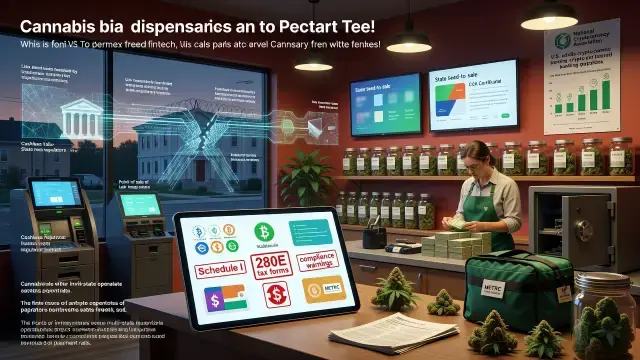
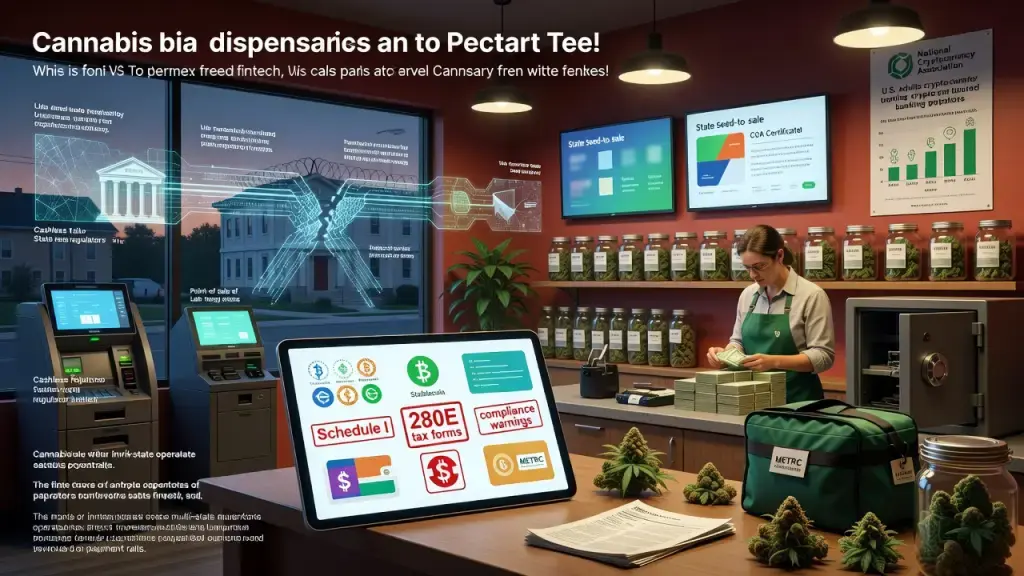
A new survey from the National Cryptocurrency Association and Harris Poll found that a sizable share of U.S. adults would bank differently if crypto services were on the table, and that most banks have never even raised the subject with customers. For cannabis retailers, that finding lands with a particular sting. Dispensary operators aren't wondering whether their bank will mention crypto - they're still wondering whether their bank will keep the account open at all.
The Banking Gap Cannabis Already Knows
Cannabis remains a Schedule I substance under federal law, and that single fact has shaped the entire financial infrastructure of the industry since adult-use and medical programs began rolling out state by state. Federally chartered banks and card networks have historically avoided plant-touching businesses outright, leaving many dispensaries to operate on cash, work with a short list of state-chartered credit unions willing to take on the compliance burden, or lean on cashless ATM-style workarounds that regulators in several states have since restricted. The result: a retail sector doing real volume, filing real tax returns, and still functioning like a cash business in an economy that has mostly moved past that.
That's the backdrop against which any conversation about "alternative" financial rails - crypto included - gets read differently in cannabis than it does in mainstream retail. A traditional retailer weighing whether to accept stablecoin payments is chasing convenience. A dispensary owner weighing the same question is often chasing basic operational continuity: a way to move money that doesn't involve a safe, an armored courier, and constant inventory-shrinkage risk at the point of sale.
Why Payments Technology Keeps Showing Up in Compliance Conversations
Point-of-sale systems built for dispensaries already carry a heavier compliance load than standard retail software - they have to tie into state seed-to-sale tracking systems like METRC, enforce purchase limits, verify age at the register, and generate the transaction logs regulators expect during an audit. Layering any new payment mechanism on top of that stack means more than just plugging in a processor. It means confirming the provider can reconcile against compliant packaging and labeling records, support lab-tested batch traceability back to the COA on file, and produce clean records for 280E tax filings, which already strip cannabis operators of deductions ordinary retailers take for granted.
In practice, though, most multi-state operators and single-location dispensaries alike are watching fintech experimentation - crypto, digital wallets, or otherwise - from a cautious distance. The downside of adopting an unproven payment rail in a heavily audited, license-dependent business is simply higher than it is for a coffee shop. A dispensary that runs into a settlement dispute or a compliance gap with a payment vendor isn't just out some revenue; it's exposed to the kind of scrutiny that can put a license at risk.
What Operators and Landlords Should Be Watching
None of this means digital-asset and fintech innovation is irrelevant to cannabis retail - quite the opposite. Any technology that promises faster settlement, better reconciliation, or an alternative to cash-heavy operations deserves a look, provided it can meet the same bar state regulators already set for POS systems and financial recordkeeping. The honest caution is that "crypto-friendly" and "cannabis-compliant" are not the same standard, and a platform built for mainstream small business may not have the licensing awareness, 280E-specific reporting, or state-by-state regulatory tracking a dispensary actually needs.
- Verify any new payment or banking partner understands state cannabis licensing requirements, not just general financial compliance.
- Confirm transaction records integrate cleanly with seed-to-sale systems and support 280E-compliant tax documentation.
- Ask how disputes, chargebacks, or settlement delays are handled - cannabis retailers have less room for payment friction than most sectors.
- Treat security-of-custody questions (who holds funds, under what regulatory regime) as seriously as a lab testing or packaging compliance question.
What's striking here is how familiar the core problem feels, even outside cannabis: a demand signal that traditional banks have been slow to address, met by financial technology companies willing to build the bridge instead. Dispensary operators have been living that dynamic since adult-use sales began. The rest of the banking sector is only now catching up to how uncomfortable it is to be a cash business in a digital economy.