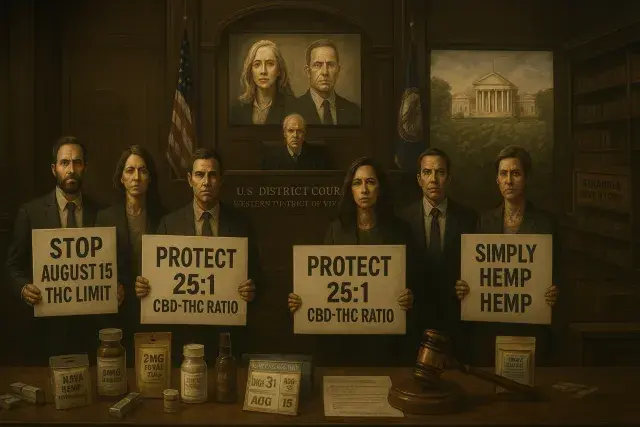
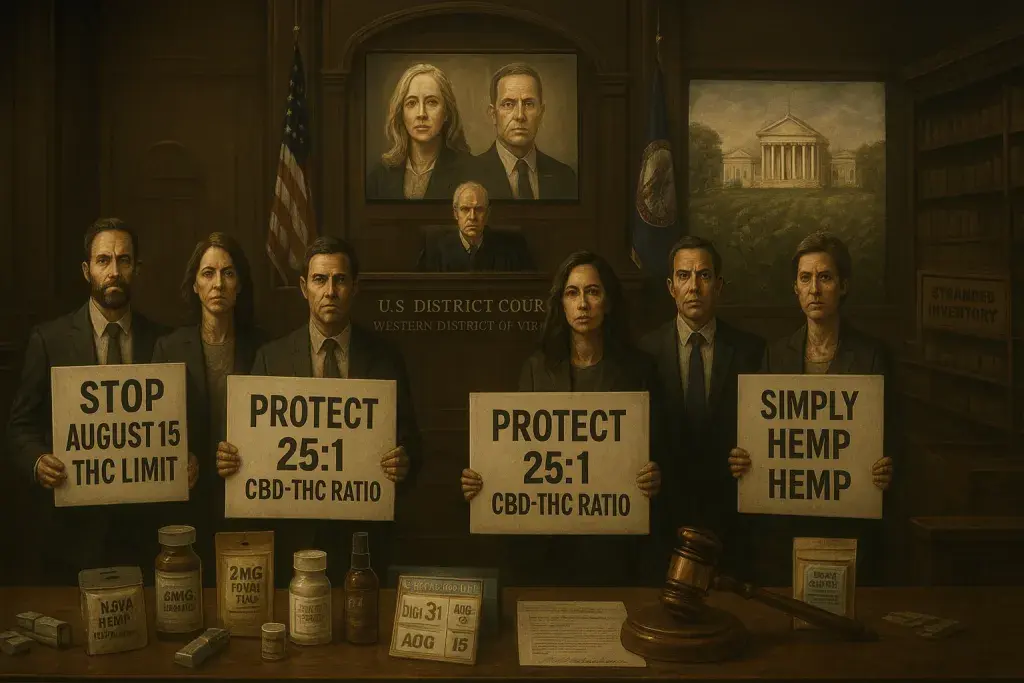
Seven Virginia hemp businesses filed suit July 31 in the U.S. District Court for the Western District of Virginia, asking a judge to block a state budget provision that eliminates a long-standing exception allowing consumable hemp products to exceed 2 milligrams of total THC per package when paired with at least 25 times as much CBD. Without that carve-out, products sold in the commonwealth must fall within the 2-mg cap and stay under the 0.3 percent total THC concentration threshold set by state law. The plaintiffs say the change, taking effect August 15, will strand inventory, force layoffs and push some operators toward closure.
The mechanics matter here, and they're worth walking through. Virginia's 2023 hemp framework, sponsored by then-Sen. Emmett Hanger, built a regulatory lane distinct from the marijuana market: independent lab testing, child-resistant packaging, warning labels, a minimum purchase age of 21, and that 25-to-1 CBD-to-THC ratio exception that let higher-potency edibles and beverages stay legal. Retail operators built supply chains, SKU management systems and wholesale relationships around that structure - not unlike how a dispensary in another jurisdiction might configure its dispensary pos ontario setup around local potency caps and packaging rules. Pull the exception without a transition window, and every product batch formulated under the old ratio becomes unsellable overnight.
What the Lawsuit Actually Claims
The complaint argues the restriction amounts to an unconstitutional taking of private property, and separately violates due process and equal protection guarantees. Plaintiffs - including District Hemp Botanicals, Nova Hemp & Agriculture, Redfern Hemp Co., Pure Elkton Manufacturing, Cypress Hemp II, Wellness Warriors and Simply Hemp - received formal notice on July 6 that the exception would disappear, leaving roughly 40 days to reformulate products, redesign compliant packaging, renegotiate manufacturing agreements and dispose of stock that no longer qualifies. That's not much runway for a retail sector that depends on lead times for co-packing, lab testing turnaround and COA verification before anything reaches a shelf.
Named defendants include Gov. Abigail Spanberger, Attorney General Jay Jones, state agriculture and cannabis regulators, and commonwealth's attorneys in the localities where the businesses operate. The plaintiffs aren't just asking for an injunction - they want damages, attorney fees and a declaration that the law is unconstitutional. Biddle, of District Hemp Botanicals, described inventory that would otherwise have to be destroyed, with no compensation mechanism currently on the table.
The Regulatory Logic Behind the Crackdown
State officials frame this differently. A Spanberger spokesman said the 25-to-1 exception became a loophole exploited by "bad faith actors," allowing intoxicating products to reach vape shops and convenience stores without the oversight applied to licensed marijuana dispensaries. That's a real compliance gap - hemp retailers generally don't operate under the same seed-to-sale tracking, security, or point-of-sale reporting obligations that licensed cannabis operators do. Attorney General Jones has said his office is prepared to defend the new standard as part of a broader shift toward a regulated adult-use market, with retail marijuana sales scheduled to begin July 1, 2027, under Virginia Cannabis Control Authority oversight.
Here's the catch, though: that regulated market doesn't exist yet. Plaintiffs point out that a consumer will legally be able to buy a 100-mg THC beverage through licensed retail in less than a year, while a much lower-dose hemp product with substantial CBD content becomes illegal now. Marijuana Justice executive director Chelsea Higgs Wise raised a related concern - that Virginia risks repeating the confusion that followed 2021 legalization, when possession became legal without clear retail guidance. She's called for a transition mechanism letting businesses clear existing inventory and clearer public messaging about what happens to product that can no longer be sold.
What Operators Elsewhere Should Watch
Virginia isn't operating in isolation. California banned detectable THC in hemp food, beverages and supplements through emergency rules and later reported broad compliance after inspecting thousands of businesses. Minnesota went the other direction, regulating hemp beverages and edibles up to 5 mg THC per serving with age gates and labeling requirements. Texas moved toward prohibition after its state supreme court upheld regulators' authority over delta-8. Layered on top of all this, a federal provision signed last year sets a 0.4 mg per-container THC limit for hemp products beginning November 12 - well below even Virginia's new 2-mg cap - though the administration has since signaled openness to revisiting the federal hemp definition.
For multi-state operators, wholesalers and brands watching this case, the through-line is straightforward: regulatory certainty and transition periods matter as much as the underlying THC threshold. Businesses that built lease obligations, staffing plans and wholesale menus around one legal definition are now absorbing the cost of a redefinition with no phase-out window. Whatever the court decides, the case is likely to shape how other states handle hemp reclassification as the federal and state rules continue diverging.