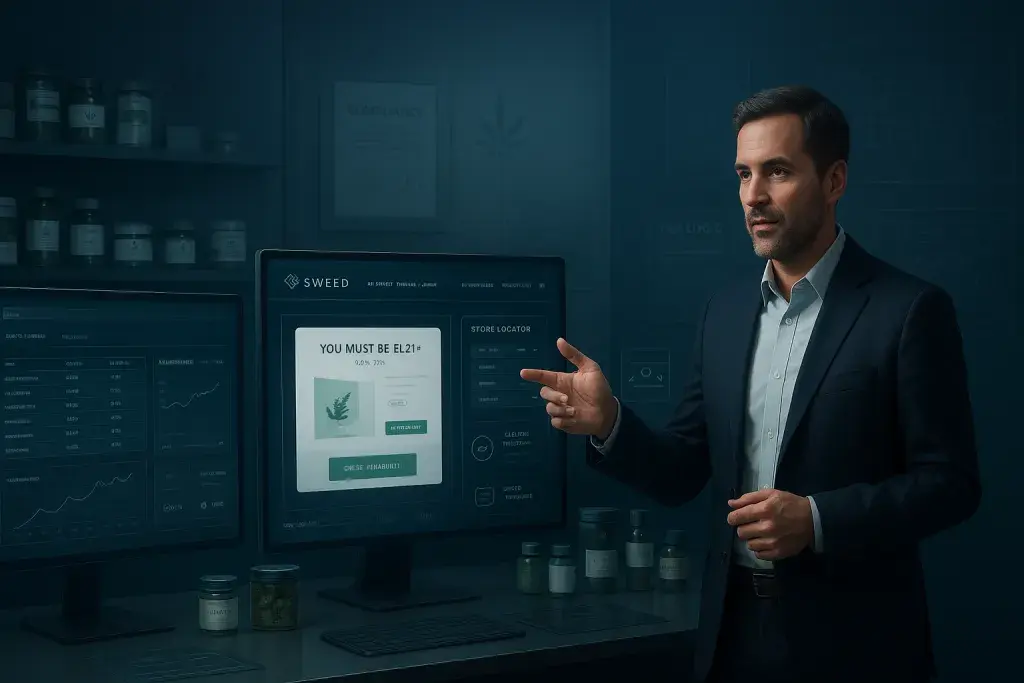
Sweed has launched a public API that lets cannabis retailers build their own storefronts while running on Sweed's backend for inventory, checkout, and compliance. The move addresses a real tension in dispensary technology: operators want distinctive, brand-driven websites, but most point-of-sale and eCommerce platforms lock them into a fixed template. Sweed's answer is to separate the two problems entirely.
The Build-Versus-Buy Problem in Dispensary Tech
Here's the catch that's dogged multi-state operators and single-location shops alike: the only real way to escape a cookie-cutter storefront has been to build a proprietary system from scratch. That sounds appealing until you count the cost. A custom POS or eCommerce build means owning your own seed-to-sale integration, your own tax logic, your own age-gate and ID verification flow, and your own exposure if any of it breaks during an audit. For an industry already carrying the weight of 280E tax treatment and state-by-state compliance rules, that's a lot of risk to take on just to get a website that doesn't look like every competitor's.
Sweed's public API is built to remove that trade-off. Retailers, agencies, and development partners get direct, real-time access to the same inventory and customer data the point-of-sale system reads - not a synced or delayed copy. In practice, that means a product marked sold out on the shelf shows sold out on the website at the same moment, which matters more than it sounds like in a compliance environment where inventory discrepancies get noticed.
Three Levels, One Contract
The rollout is structured in tiers, giving operators a choice about how much of the plumbing they want to touch:
- Catalog API - pulls product and promotional data onto a retailer's own site, no checkout logic involved.
- Headless eCommerce API - available now, covering accounts, checkout, cart, payments, and compliance behind a custom-built storefront.
- Full Headless UI - coming soon, aimed at teams that want total interface control while still leaning on Sweed for compliance logic, loyalty, promotions, and order tracking.
That tiered structure is a practical acknowledgment that not every dispensary group has the same engineering bench. A single-store operator might stop at the catalog layer. A multi-state operator with an in-house dev team might push all the way to full headless control. Either way, the compliance and payment mechanics stay on Sweed's side of the wall, which is the part regulators actually care about.
Why Stability Matters More Than Features
Rocco Del Priore, Sweed's co-founder and president, framed the launch as a long-term commitment rather than a reaction to competitive pressure, pointing to a pattern familiar to anyone who has built on top of a vendor API that later got sunset or restructured. A stable, single-schema contract is not a glamorous selling point, but for a development team planning a storefront build, it's the difference between a defensible roadmap and a project that needs rework every time a partner changes course.
The rollout also includes a library of embeddable components - age-gate verification, store locators, product carousels, and an AI-guided product finder that asks shoppers about category, effect, flavor, and strength before returning ranked suggestions. These are consumer-facing tools, so the compliance stakes are real: age verification and accurate, lab-backed product information aren't optional extras in regulated cannabis retail, they're the baseline. Building them once, centrally, and maintaining them across every retailer using the API is a more defensible compliance posture than each operator patching together its own version.
What This Signals for the Retail Tech Market
For payment providers, POS vendors, and eCommerce platforms serving the cannabis industry, this is a marker worth watching. Retail technology in adult-use and medical markets has been trending toward separating the compliance backbone from the customer-facing brand experience - not unlike how mainstream retail decoupled checkout infrastructure from storefront design years ago. Dispensary operators evaluating this kind of integration should still ask the basic diligence questions: how compliance logs are maintained, how payment data is secured, and how quickly the platform adapts when state rules on labeling, taxation, or advertising shift. An API is only as good as the compliance discipline running underneath it.