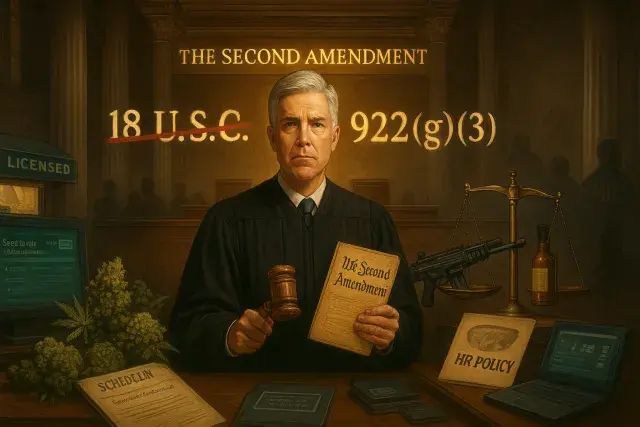
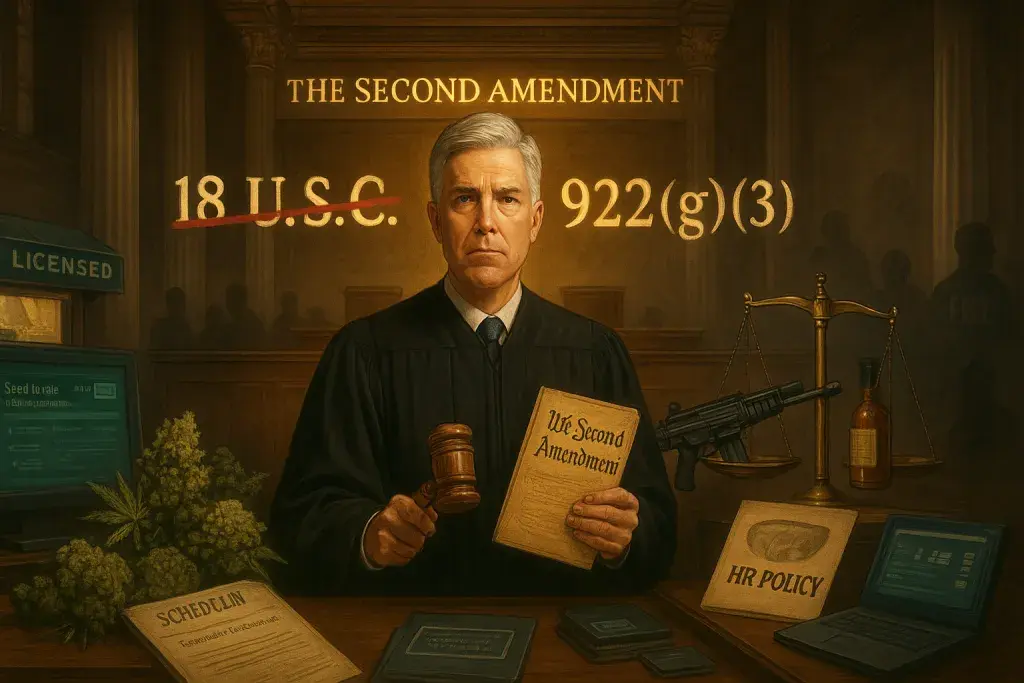
The U.S. Supreme Court handed down a unanimous decision Thursday striking down, as applied to a recreational marijuana user, the federal statute that automatically bars cannabis consumers from owning or purchasing firearms. The ruling in United States v. Hemani does not erase 18 U.S.C. § 922(g)(3) from the books - but it does establish that the government cannot categorically strip Second Amendment rights from someone who uses marijuana occasionally without any individualized showing of danger. For licensed cannabis businesses, compliance officers, and the broader regulated industry, the decision lands at a moment of acute federal policy tension and carries real operational implications.
Justice Neil Gorsuch authored the majority opinion, joined by six other justices, with three separate concurrences filed alongside it. The ruling turns on the government's failure to demonstrate a historical tradition of disarming people simply because they use a substance that law enforcement widely tolerates and that most states have legalized in some form. That framing matters well beyond the courtroom. Operators tracking how federal policy intersects with state-legal retail - whether through dispensary software vermont providers or multi-state compliance platforms - have long understood that the mismatch between federal prohibition and state legalization creates friction across everything from banking access to background checks for employees who may also be cannabis consumers.
The opinion draws a pointed comparison: marijuana use today, the court said, is functionally analogous to alcohol use at the nation's founding - widespread, broadly tolerated by law enforcement, and increasingly considered socially acceptable. The court noted that some surveys suggest more adults now regularly use marijuana than consume alcohol. That's not a small population to categorically disarm, and the court said the government's own regulatory moves - particularly the partial rescheduling of cannabis from Schedule I to Schedule III - undercut its argument that marijuana users are inherently and categorically dangerous.
What the Ruling Actually Says - and What It Deliberately Leaves Open
Here's the catch: this is a narrow decision. Gorsuch was explicit about what the court did not decide. The opinion does not address bans on firearm possession by people who are currently intoxicated. It does not address addicts. It does not touch the felony disqualification provision under § 922(g)(1), which remains fully intact and continues to apply to anyone convicted of a drug-related felony - including cannabis offenses in jurisdictions where state and federal law still conflict. The court also left open the possibility that Congress could craft more targeted legislation, backed by individualized proof or drug-specific evidence of danger, that might survive constitutional scrutiny.
What the court rejected, plainly, is the government's broadest theory: that any regular use of any controlled substance, in any amount, with no showing of impairment or danger, is sufficient grounds to permanently disarm a person and threaten them with up to 15 years in federal prison. That theory, Gorsuch wrote, would give the government power to designate any group as dangerous and disqualify its members from gun ownership - a risk the court said would effectively hollow out the Second Amendment.
The Rescheduling Contradiction the Court Couldn't Ignore
The timing of the federal rescheduling process became an unexpected variable in the case. After oral arguments were heard in March, the government moved certain marijuana products to Schedule III - a classification reserved for substances with lower abuse potential and recognized medical use. The court noted the obvious tension: the same federal government arguing that cannabis consumers are categorically dangerous simultaneously took regulatory action acknowledging that cannabis has accepted medical applications and a lower risk profile than Schedule I substances.
That contradiction is not lost on the cannabis industry, which has spent years operating in the space between federal prohibition and state-legal retail. Licensed dispensaries have navigated 280E tax burdens, limited banking access, cash-heavy operations, and compliance requirements built on a federal schedule that the rescheduling process is now quietly dismantling. The court's opinion, in effect, called out what operators have known for years: federal cannabis policy has been incoherent, and the government cannot simultaneously fuel a multi-billion-dollar state-legal market and treat every participant in that market as presumptively dangerous.
Practical Implications for Licensed Cannabis Businesses
For dispensary operators and multi-state companies, the Hemani decision doesn't change daily retail operations directly. Point-of-sale compliance, seed-to-sale tracking, age verification, and state licensing requirements are unaffected. But the ruling does shift the broader legal environment in ways that matter for hiring, HR policy, and background check procedures - particularly for businesses in states where employees may lawfully use cannabis off-duty.
The decision also raises questions about how the Justice Department will instruct federal prosecutors going forward. The Biden DOJ had already issued guidance counseling discretion in cannabis prosecutions; the Trump administration's posture has been more aggressive in some respects while simultaneously pursuing rescheduling. Operators with legal counsel monitoring federal compliance exposure - especially those with vertically integrated licenses or significant federal nexus - should expect this ruling to prompt updated prosecutorial guidance, even if the underlying statute remains on the books.
The political fallout is already visible. Prohibitionist groups like Smart Approaches to Marijuana have pledged to work with allies in Congress to craft new legislation consistent with the court's narrow ruling. That means the industry should anticipate future legislative attempts to define more targeted categories of cannabis users who could still be disqualified from firearm ownership - proposals that will likely re-enter the compliance conversation as Congress debates federal cannabis reform more broadly.
The court drew a line Thursday. The government cannot treat every cannabis consumer as a categorical threat. What happens next - in Congress, in the rescheduling process, and in federal courtrooms - will determine how wide that line actually holds.