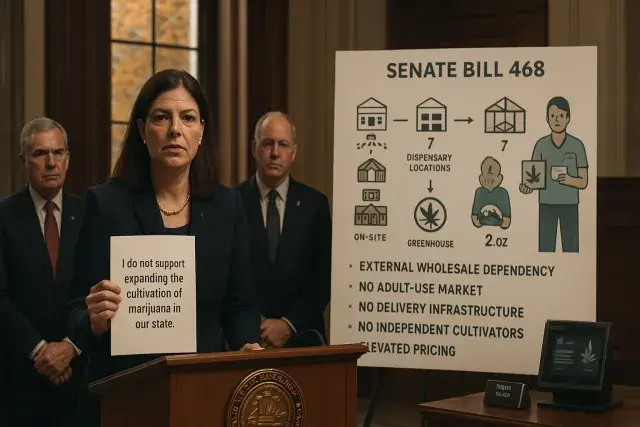
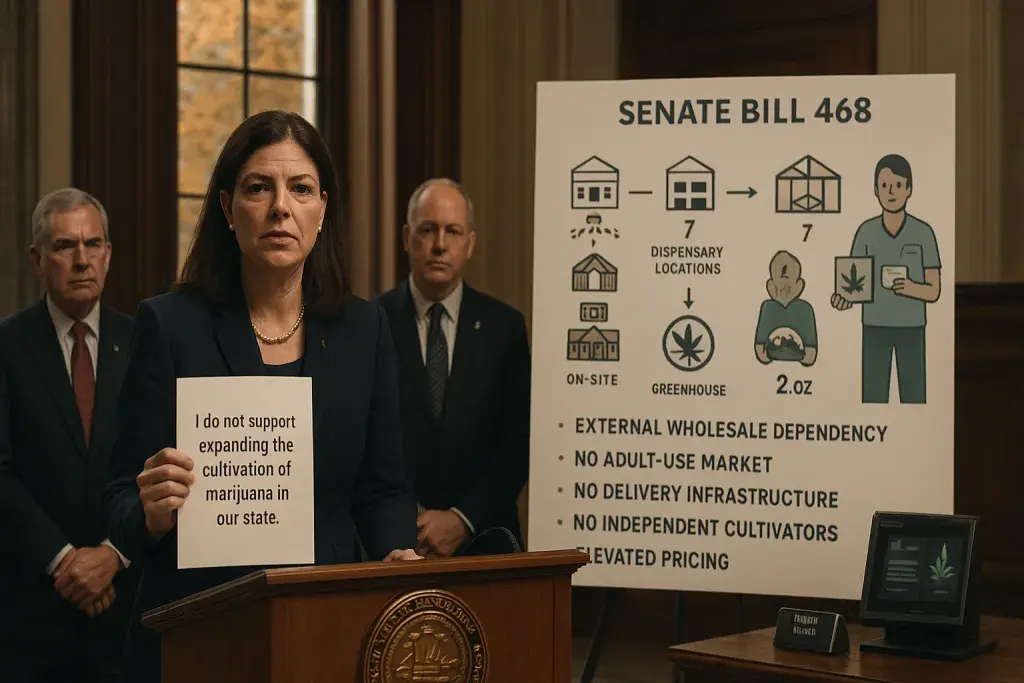
New Hampshire's four licensed alternative treatment centers will not be getting on-site greenhouses anytime soon. Governor Kelly Ayotte vetoed Senate Bill 468 on Friday, ending a bipartisan attempt to ease supply constraints and bring down prices for the state's medical cannabis patients. The bill, sponsored by Republican Sen. Howard Pearl of Loudon, was narrowly focused - one greenhouse per dispensary, no more - but that was enough for Ayotte to reject it outright.
The veto lands in a state with one of the most restrictive medical cannabis frameworks in the country. New Hampshire has seven dispensary locations total, all operated by one of four nonprofit alternative treatment centers, serving patients who must hold a physician-issued medical card and are capped at two ounces of cannabis. There is no adult-use market, no delivery infrastructure, and no licensed wholesale or independent cultivator tier to speak of. The supply chain, in other words, runs entirely through those four operators - which means pricing pressure has nowhere to go. Operators in states that have built out more competitive cultivation and wholesale markets, and invested in tools like cannabis pos systems alaska, have generally seen prices moderate over time as supply-side competition increases; New Hampshire's structure works against that mechanism by design.
SB 468 was not a dramatic expansion proposal. It did not open cultivation to new entrants, create a new license class, or touch the state's existing patient access rules. It simply would have allowed existing, already-licensed dispensary operators to grow a portion of their own inventory on-site - a common feature in vertically integrated medical markets elsewhere. The argument for it is straightforward: when the only dispensaries in your state are also entirely dependent on external supply, cost control is limited, and patients absorb the difference at the register.
What the Veto Actually Signals
Ayotte's veto statement offered four words as its core rationale: "I do not support expanding the cultivation of marijuana in our state." That's a policy position, not a regulatory finding. There was no compliance objection, no public safety mechanism cited, no concern about seed-to-sale tracking or cultivation oversight - just a blanket opposition to growing more cannabis in New Hampshire, full stop.
That matters for operators and anyone watching the state's regulatory posture. New Hampshire is already the last New England state without a recreational market. Ayotte has publicly opposed adult-use legalization on grounds including impaired driving detection and youth mental health - concerns shared by some regulators and public health professionals elsewhere, though the policy conclusions drawn from them vary widely. The greenhouse veto suggests those objections extend further than recreational access. They appear to reach into the medical program itself, even where the structural argument for expanded cultivation is patient-centered and supply-focused rather than commercial.
For the state's four alternative treatment centers, this is a real operational constraint. They cannot optimize inventory against demand the way a vertically integrated operator in a larger market might. They cannot use on-site cultivation to buffer against wholesale price swings or shortfall. Their budroom menus are limited by whatever external supply they can source - and in a state with no licensed independent cultivators feeding a wholesale tier, that supply chain is thin.
The Override Math and What Comes Next
Overriding Ayotte's veto requires a two-thirds majority in both the House and Senate - a high bar under any circumstances, and particularly so in a state where the governor's opposition is categorical rather than conditional. The Legislature is expected to vote on an override later this year. Whether the bipartisan coalition that backed SB 468 can hold together and expand is an open question.
What's striking here is that this wasn't a divisive bill along predictable lines. Pearl, the sponsor, is a Republican. The effort drew support across the aisle. The operational ask was modest. And yet the veto came without apparent negotiation over amendments, regulatory safeguards, or cultivation caps that might have addressed any specific concern. That leaves medical cannabis operators in the same position they've been in since 2013: structurally constrained, geographically isolated from any competitive wholesale market, and dependent on a framework that was designed to be limited.
For dispensary owners, compliance officers, and anyone tracking regulated cannabis retail in the Northeast, the New Hampshire situation is worth watching - not because the market is large, but because it illustrates how supply-side policy decisions translate directly into patient-level pricing and access. A greenhouse is not a gray area. It's a cultivation site, subject to the same tracking, inspection, and compliance requirements as any other licensed grow operation. The argument that adding one per dispensary constitutes an unacceptable expansion is a political judgment. The operational consequences of that judgment fall on operators and patients alike.