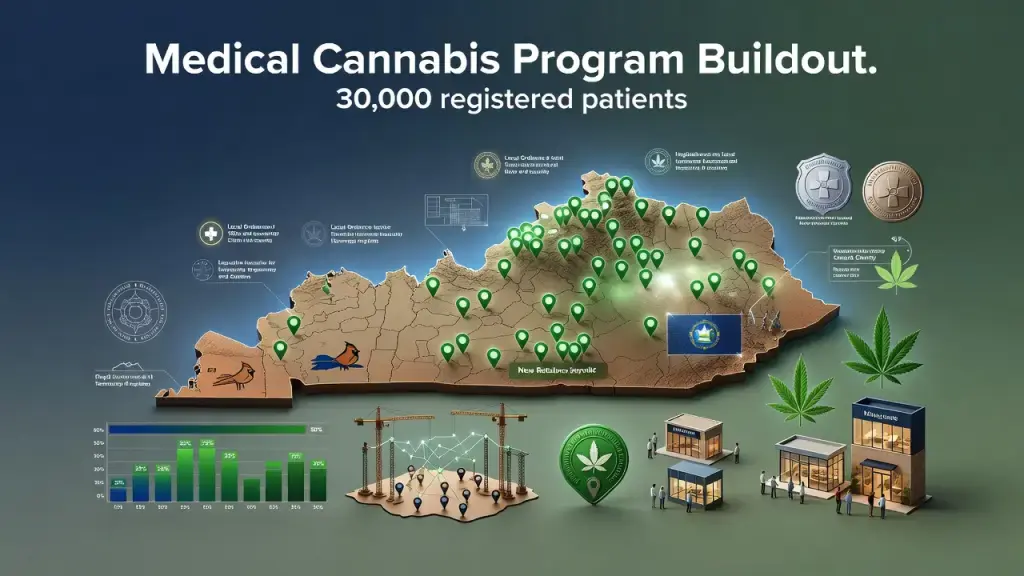
Kentucky's medical marijuana program has crossed 30,000 registered cardholders, Lt. Gov. Jacqueline Coleman (D) announced Thursday, with regulators now past the halfway point in licensing the state's full slate of approved dispensaries. The milestone lands roughly two years after the state's legalization law took effect and less than a year after the first dispensary opened its doors in December 2024.
For a program that spent much of its first year under criticism for slow rollout, the numbers suggest the buildout has finally found a rhythm. Forty-seven of 80 approved businesses are now operational, including a newly opened retailer in Maysville that brings the statewide dispensary count to 27. Coleman also noted that more than 500 medical practitioners are now certified to recommend cannabis to patients - a figure that matters more than it might seem, since patient access depends entirely on physician willingness to issue certifications, not just on shelf space at a dispensary.
Why Practitioner Access Shapes the Patient Pipeline
Cardholder counts don't rise on their own. Every new patient has to clear two gates: a qualifying health condition and a certifying practitioner willing to sign off. Kentucky's list of qualifying conditions expanded this year after Gov. Andy Beshear used executive authority to add 15 additional disorders - including Parkinson's disease, HIV/AIDS, sickle cell anemia, fibromyalgia, arthritis and glaucoma - after the legislature declined to act on the issue this session. That expansion widened the funnel considerably. More eligible patients, paired with a growing roster of certifying physicians, is the mechanism behind the 30,000-cardholder figure, not simply increased public interest.
That expansion hasn't gone unchallenged. House Majority Whip Jason Nemes (R) asked the attorney general to direct state agencies not to cooperate with the governor's directive, calling it unlawful and suggesting licensees who comply could face prosecution. Beshear pushed back hard, framing the pressure campaign as an attack on patients with terminal diagnoses. For operators and licensees caught in the middle, the dispute is a reminder that medical cannabis programs built on executive orders carry a different risk profile than those codified through statute - compliance teams need to watch not just regulatory updates but the legal durability of the rules they're following.
What the Buildout Pace Means for Operators
Forty-seven of 80 licensed businesses operating means roughly 33 approved locations have yet to open. For prospective dispensary operators and their landlords, that's a meaningful pipeline still working through construction, local permitting, and final licensing checks - not unlike the slow-motion build-out patterns seen in other new medical markets. Dispensaries are now open in all 11 of the state's licensing regions following an opening in Floyd County, which matters for supply chain planning: wholesalers and cultivators no longer need to guess which regions will have retail access and which won't.
Beshear has acknowledged the pace has been a source of frustration, saying in January he wasn't "satisfied" with implementation speed, though he expects patient access to accelerate through 2026. The state waived card renewal fees for patients who registered before retailers in their area opened - a modest but practical accommodation given that patients were paying into a system they couldn't yet use.
Local Buy-In and the Road Ahead
More than 100 Kentucky cities and counties approved local ordinances allowing medical cannabis businesses during the November 2024 election, a result Beshear pointed to as evidence that voter support crosses party lines and geography. That local approval layer is worth flagging for any multistate operator eyeing Kentucky: zoning and municipal buy-in remain a separate hurdle from state licensing, and operators still need both before a storefront can open.
Separately, a legislative committee held a hearing in July on allowing terminally ill patients to use medical marijuana in hospital settings - a question with real implications for institutional pharmacy policy, liability, and how compliant product moves through a clinical environment rather than a retail one. As Kentucky's dispensary count climbs toward full buildout, these secondary policy questions, not just store openings, will determine how functional the program actually becomes for patients who need it most.