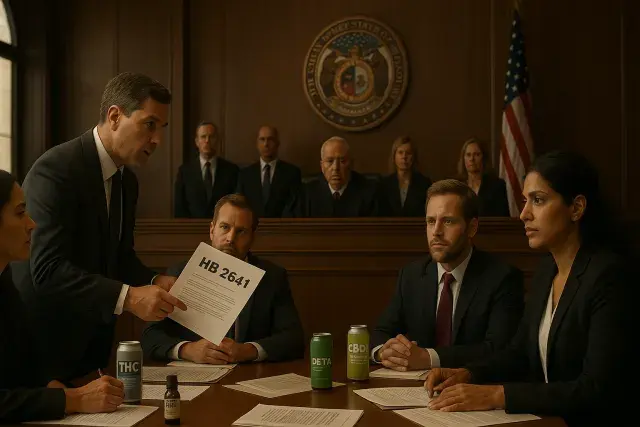
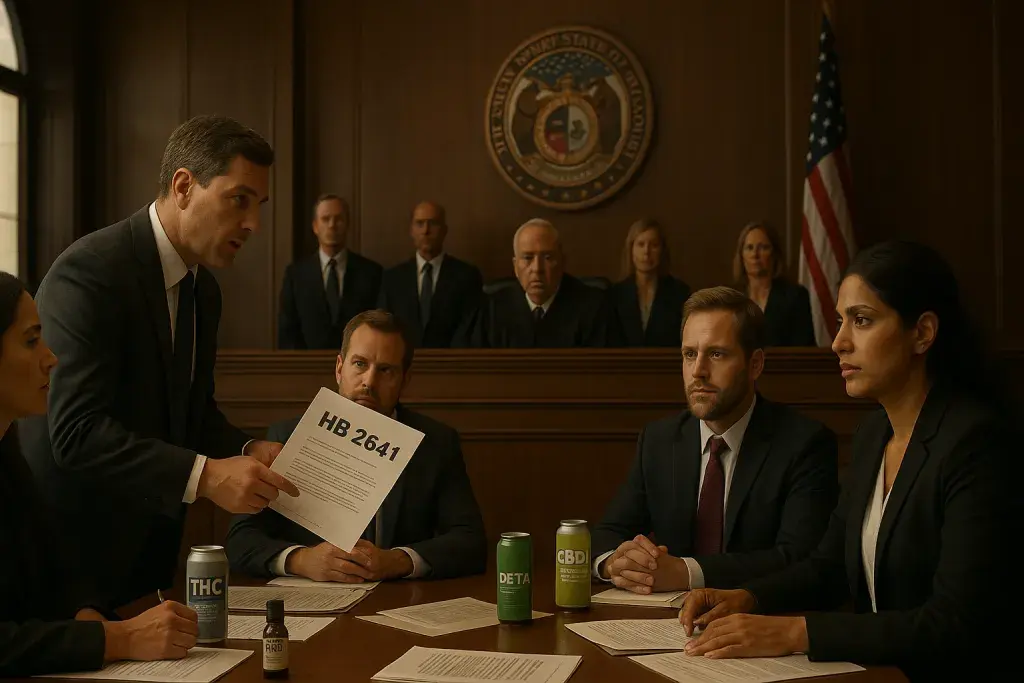
A coalition of Missouri hemp businesses filed a federal lawsuit Thursday seeking to block a statewide ban on intoxicating hemp products before it takes effect November 12. Filed in the U.S. District Court for the Western District of Missouri, the suit targets legislation Gov. Mike Kehoe signed earlier this year - one of the first bills to cross his desk - and argues the law's definitions of "hemp" and "marijuana" are so contradictory that businesses, prosecutors, and law enforcement cannot determine what is actually legal to sell, transport, or possess.
The plaintiffs include St. Louis-based MNG 2005, Inc., parent company of 55 CBD Kratom retail locations nationwide, the Missouri Hemp Trade Association, and Wisconsin-based Lifted Liquids Inc. At stake is an entire product category - THC seltzers, hemp-derived cannabinoid products, and CBD goods - currently sold in bars, grocery stores, and smoke shops outside the licensed marijuana dispensary channel. For operators tracking how state-level hemp regulation is evolving market by market, resources like indicaonline.com offer a useful frame of reference for how compliance obligations differ across regulated cannabis states. The Missouri situation, though, is a sharper edge case than most: the law threatens to pull non-intoxicating CBD products off shelves alongside delta-8 and delta-9 drinks, according to the coalition.
The law, known as HB2641, largely mirrors the federal hemp ban Congress approved last year and tasks Missouri Attorney General Catherine Hanaway with enforcement. Named defendants include Hanaway, Kehoe, and Sarah Wilson, director of the Missouri Department of Health and Senior Services, which oversees the state's licensed marijuana program. Hanaway's office had not yet been served as of Thursday. Kehoe's office and DHSS declined to comment, citing pending litigation.
Where the Legal Argument Lives
The coalition's core complaint isn't that Missouri wants to regulate intoxicating hemp - it's that the legislature drafted the law carelessly enough to create genuine constitutional problems. The suit argues that HB2641 defines the same products as both "hemp" and "marijuana" in different provisions. That's not a minor drafting glitch. Because unlicensed marijuana activity is a criminal offense in Missouri, any ambiguity in those definitions carries criminal consequences for retailers, transporters, and distributors who think they're operating in the clear.
Craig Katz, government relations and compliance manager for MNG 2005, put it plainly: lawmakers don't always understand the technical distinctions that separate a federally compliant hemp product from a controlled substance, and HB2641 reflects that gap. "A lot of this stuff is kind of in the weeds," Katz said. "When people are trying to legislate it, if they don't understand it, you come up with something like HB2641, which doesn't make a whole heck of a lot of sense." That's not a throwaway line - it describes a real structural problem that compliance professionals in the hemp and cannabis space deal with constantly as state legislatures try to catch up with a product category that federal law created somewhat accidentally through the 2018 Farm Bill.
The lawsuit also targets the bill's interstate commerce provisions. While HB2641 ostensibly promises not to interfere with interstate hemp transport, the coalition argues it simultaneously restricts who may move hemp products through Missouri - a potential Commerce Clause problem. And the law's effective date provisions, the suit contends, are "so convoluted that businesses cannot determine which products are covered or when." For any licensed hemp business managing inventory, labeling, and distribution schedules, that kind of ambiguity isn't just frustrating - it's operationally paralyzing.
The Licensed Dispensary Angle
Here's where this gets complicated for the regulated marijuana industry specifically. Under HB2641, if Congress reverses course and allows intoxicating hemp products to remain on the market, Missouri would restrict their sale exclusively to licensed marijuana dispensaries. That sounds like a windfall for the licensed channel - and in a narrow sense it is. But it also cements a government-mandated monopoly structure, as Missouri Hemp Trade Association president Jay Patel put it: "This isn't consumer protection. It's the elimination of an entire legal industry coupled with a government-mandated monopoly."
Dispensary operators who've watched hemp-derived THC beverages eat into their product margins at off-license retail points might see some short-term benefit if the ban holds. But the broader implication - that a poorly written law could expose any business in the supply chain to criminal liability based on definitional confusion - is a problem for the licensed marijuana industry too. If prosecutors and law enforcement can't distinguish hemp from marijuana under the statute, that enforcement ambiguity doesn't stay neatly contained to the unlicensed smoke shop market.
What Comes Next for Retailers and Operators
The November 12 effective date is close. Any hemp retailer currently moving intoxicating products in Missouri - or transporting them through the state - is now operating in legal limbo, with a lawsuit in progress and no preliminary injunction yet in place. The coalition will almost certainly seek emergency relief to halt enforcement while the case proceeds; whether the court grants it depends on how quickly the plaintiffs can establish likelihood of success on the merits and irreparable harm.
Bill sponsor Rep. Dave Hinman (R-O'Fallon) was direct in his skepticism: "I believe this is the last ditch effort for the hemp industry. HB2641 passed the Missouri House, Senate and was signed by the governor. It was vetted throughout the entire process." Fair enough - it passed. But a bill clearing the legislative process doesn't immunize it from constitutional challenge, and the "unconstitutionally vague" argument has real teeth when criminal penalties attach to undefined terms.
For compliance professionals, the Missouri case is a reminder that state hemp laws written in the shadow of a federal ban can produce serious ambiguities - ambiguities that fall hardest on businesses trying to maintain compliant product lines, manage SKU-level documentation, and make informed decisions about inventory. Watching how the court responds to the vagueness argument will matter well beyond Missouri's borders.