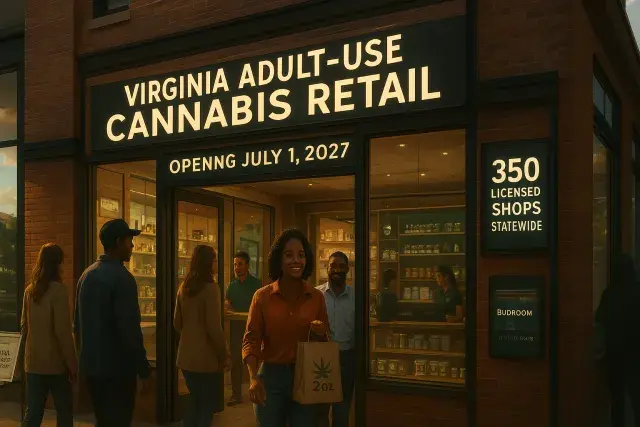
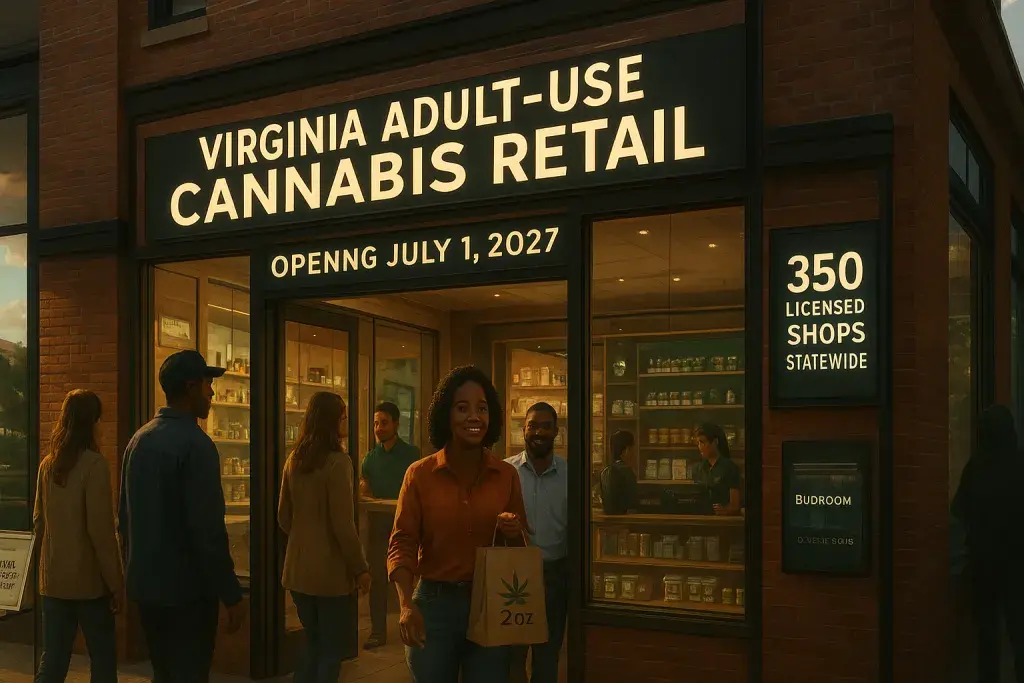
Virginia has enacted legislation authorizing recreational cannabis retail sales, making it the first Southern state to build a regulated adult-use market after legalizing possession back in 2021. The state budget bill signed into law this week sets a July 1, 2027, launch date for licensed recreational sales to adults 21 and older, with the state accepting retail license applications beginning February 1. Up to 350 cannabis shops will be permitted to operate statewide under the new framework.
For operators already working in regulated markets elsewhere - or those watching Virginia as a potential entry point - the licensing structure, tax framework, and possession limits now provide a clearer picture of what building here will require. Compared to mature markets like Colorado or California, Virginia's capped license count and defined application window give early movers a narrow but real advantage. Operators familiar with the compliance demands of a cannabis retail platform for Alaska will recognize the general architecture: state-controlled licensing, mandatory product testing, age verification requirements, and an excise tax layered on top of standard sales tax. The specifics differ, but the operational discipline required is consistent across regulated markets.
The state projects roughly $51 million in combined excise and sales tax revenue in the program's first year, according to legislative budget documents. That figure gives wholesalers, brands, and ancillary vendors a rough sense of market scale at launch - modest by the standards of larger states, but meaningful for a market that has been operating without a legal retail channel for years. In practice, Virginia's illicit market has been filling that gap since 2021, when possession was decriminalized but retail sales were not authorized. That's a structural problem every regulated market faces in its early phase, and one that Virginia's own lawmakers acknowledged directly.
What Operators Need to Understand About the Licensing Timeline
The February 1 application window is roughly 18 months out from writing, which sounds like sufficient runway. It isn't - not if operators are starting from scratch. Real estate negotiation, local zoning approvals, build-out timelines, and technology procurement all run concurrently with the licensing process. Dispensary operators who've opened in other states know that securing a compliant location and completing a build-out that satisfies state inspection requirements can easily consume 12 months on its own.
Virginia's existing medical cannabis dispensaries - which have been operating under the state's earlier program - will likely hold a structural advantage here. They have staff trained in seed-to-sale tracking, point-of-sale compliance, and state reporting protocols. They may also already carry relationships with tested product vendors and wholesale suppliers. New entrants will need to build that infrastructure from the ground up, including integrating POS systems capable of handling age verification, purchase limits, and real-time inventory reporting as the state mandates.
The possession limit increase - from 1 ounce to 2 ounces - has a direct retail implication. Higher possession caps generally correlate with larger average transaction sizes and different inventory planning requirements. Operators will need to think carefully about SKU depth, budroom layout, and product mix to serve both experienced consumers and first-time adult-use buyers who previously had no legal retail option.
Tax Structure and the Illicit Market Problem
Virginia's dual-tax approach - an excise tax stacked on top of sales tax - is standard architecture for adult-use markets, modeled loosely on the alcohol regulatory framework. The practical challenge is familiar to any operator who has worked in a high-tax state: if the combined tax burden pushes retail prices above what the illicit market charges, licensed stores struggle to pull consumers out of unregulated channels. State Sen. Lashrecse Aird put it plainly when the legislation was being debated - the legal marketplace needs to be "affordable and accessible enough to actually compete."
That's the tension every regulated cannabis market manages. Lab-tested, compliantly packaged products with accurate COAs cost more to produce and sell than untested, unlicensed product. The tax layer widens that price gap further. Virginia will need to monitor its retail price point carefully during the program's early years, and operators should build financial models that account for the reality that the state's tax take will come off the top of every transaction regardless of competitive pressure below.
Equity Provisions and Compliance Risk
Virginia's legislation carries a social equity dimension that operators should take seriously, not just as a policy statement but as a compliance and reputational matter. The state's own data showing disproportionate enforcement against Black Virginians was central to the legislative argument for legalization. One provision in the final bill - an increased civil fine for public consumption - drew pushback from advocacy organizations who argued it could replicate the same enforcement disparities the broader legislation was meant to address.
For licensed operators, this means the regulatory environment in Virginia will likely remain politically sensitive. Compliance logs, employee training on responsible retailing, and clear posted policies around consumption and age verification aren't just state requirements - they're the operational baseline for avoiding becoming a political target in a market where the equity debate is still very much active. The difference between a store that passes inspection and one that becomes a liability often comes down to documentation discipline and staff training rigor, not product quality.
Virginia is now one of roughly half the U.S. states that permit adult recreational use. It remains an outlier in the South, where most states maintain stricter restrictions. That regional position cuts both ways for operators: less local competition in the near term, but also a more politically cautious regulatory agency and a legislative coalition that required years of compromise to get this far. July 1, 2027, is the target. Whether the state hits that date cleanly will depend on how quickly its regulators can stand up an application and review process that doesn't become its own bottleneck.