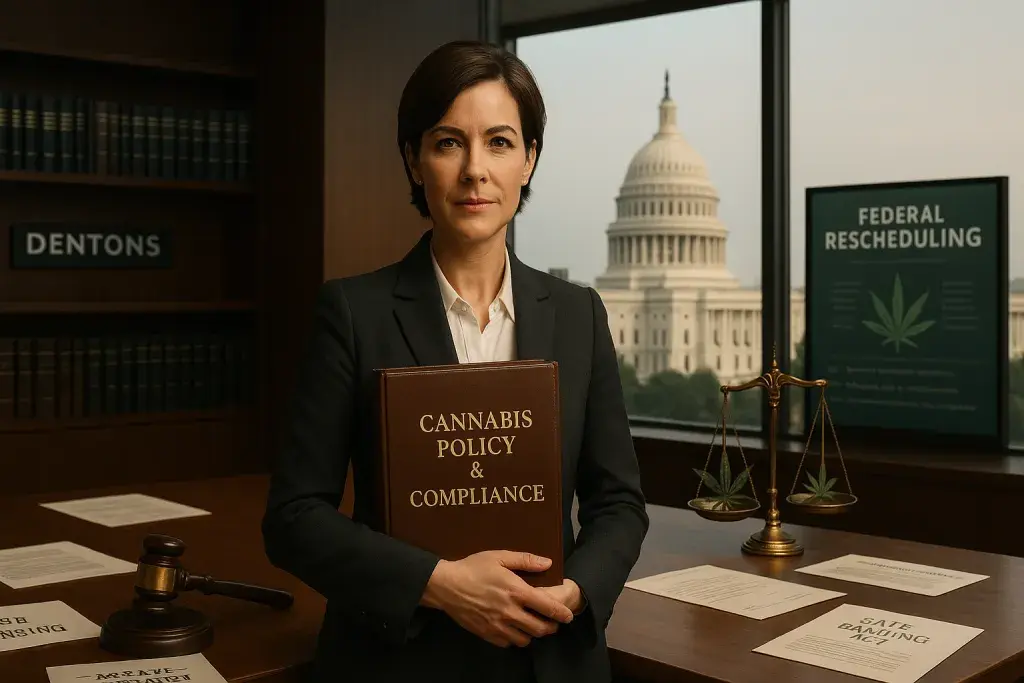
Kelly Fair, a seasoned legal and regulatory strategist with more than two decades of experience in cannabis policy, corporate compliance, and mergers and acquisitions, has joined Crestwood Strategies as principal and strategic partner. Fair comes to the Washington, D.C.-based government relations and public affairs firm from Dentons US LP, where she served as general counsel and partner across the firm's cannabis and healthcare practices. The move signals a deepening intersection between high-level legal expertise and the federal advocacy work that increasingly shapes how licensed cannabis operators do business.
That intersection matters now more than ever. State-licensed cannabis operators - from single-store dispensaries to multi-state operators managing dozens of SKUs across complex compliance frameworks - are acutely aware that decisions made in Washington often ripple directly into their POS terminals, wholesale menus, and tax filings. Firms like Crestwood sit at the pressure point between federal inaction and state-level regulatory sprawl, a position that demands both legal fluency and political traction. Operators in emerging adult-use markets are particularly exposed: a dispensary working to configure cannabis POS for Minnesota dispensaries, for example, must simultaneously track seed-to-sale reporting obligations, state excise tax structures, and the possibility that federal rescheduling or banking reform could reshape their compliance stack with relatively little notice.
Fair's background covers precisely the terrain where those pressures converge. Her work in hemp and cannabis policy, corporate strategy, and M&A in emerging industries puts her in position to advise on the full arc of a regulatory matter - from the drafting of state licensing frameworks to the due diligence required when a cannabis brand or multi-state operator weighs an acquisition. That breadth is not incidental. The cannabis industry has a persistent shortage of professionals who can move fluently between the technical demands of compliance, the strategic calculus of corporate transactions, and the slower, more opaque work of shaping policy before it hardens into statute.
What Government Relations Firms Actually Do for Cannabis Operators
Crestwood operates across government relations, public affairs, and legal and regulatory advisory services from its Washington, D.C. offices. In the cannabis context, that work typically involves monitoring and engaging on federal legislation - think the SAFE Banking Act and its various iterations - as well as supporting state-level regulatory proceedings that determine license structures, product rules, or advertising restrictions. The thing is, many licensed operators underestimate how directly this advocacy work affects their day-to-day operations. Banking access, the reach of 280E, packaging and labeling standards, and even delivery rules often trace back to policy decisions shaped in part by the firms and attorneys who engage regulators before the rules are finalized.
For dispensary owners and multi-state operators navigating compliance costs that can strain margins - particularly under 280E, which disallows standard business deductions for cannabis businesses operating in a Schedule I environment - having experienced regulatory counsel engaged at the policy level is not a luxury. It's a structural necessity. Fair's addition gives Crestwood a principal who has worked those matters from the inside of a major international law firm, with direct exposure to cannabis and healthcare regulatory clients facing exactly those pressures.
Why Legal Depth at the Policy Level Has Operational Consequences
Here's the catch with cannabis regulation: by the time a rule appears in a state's administrative code or a federal agency issues guidance, the window for meaningful operator input has often closed. That's why representation earlier in the process - during legislative drafting, agency rulemaking, or interagency consultation - can determine whether a compliance requirement is workable in practice or becomes an inventory-tracking burden that no off-the-shelf software handles cleanly.
Fair's M&A background adds another layer of value that's easy to overlook. Cannabis consolidation hasn't stopped - operators continue to weigh acquisitions, licensing transfers, and vertical integration strategies even in a tight capital environment. Those transactions require counsel who understands not just deal mechanics, but the regulatory contingencies that can unwind a cannabis acquisition: unresolved compliance violations, license transfer restrictions, or undisclosed exposure in a target company's seed-to-sale records. Bringing that experience into a government relations and public affairs context, rather than keeping it siloed in transactional practice, reflects how sophisticated the cannabis policy environment has become.
A Broader Signal for the Industry's Policy Infrastructure
What's striking here is the trajectory this hire represents. Cannabis policy work has matured past the point where a general lobbying firm with a cannabis practice group can credibly serve an industry facing this level of regulatory complexity. Operators, investors, and trade associations are increasingly seeking advisors who have sat in the rooms where compliance frameworks get built - not just professionals who know how to schedule a meeting on the Hill.
Fair's move to Crestwood reflects that shift. The cannabis industry's policy infrastructure is catching up, slowly but measurably, to the complexity of the business it represents.