
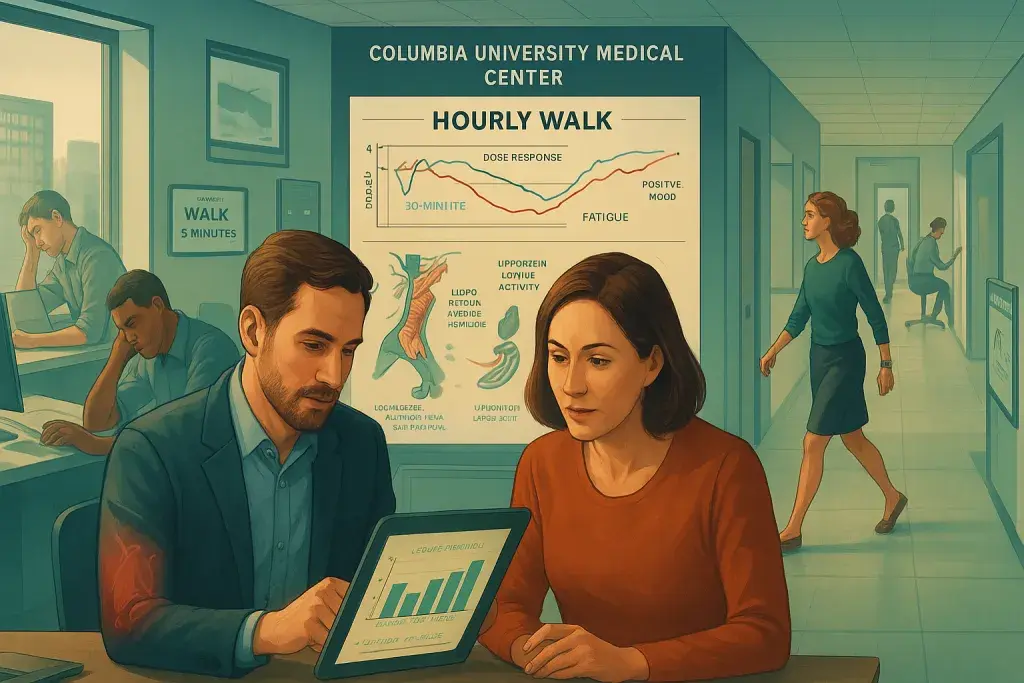
A Columbia University Medical Center study published this week in the British Journal of Sports Medicine has done something decades of public health messaging failed to do: it answered the specific dose question. Five minutes of walking every hour - not vague encouragement to "move more" - produced meaningful reductions in fatigue and improvements in mood among desk workers, validated across 11,484 adults in real workplaces across all 50 US states. This is the largest real-world test of workplace movement breaks ever conducted, and the findings carry direct implications for how employers structure the workday.
That scale matters. Previous movement-break research almost exclusively took place in controlled lab environments - useful for understanding biological mechanisms, limited for understanding what ordinary workers will actually sustain between meetings and deadlines. The new study, led by Columbia exercise physiologist Keith Diaz in collaboration with NPR journalist Manoush Zomorodi, ran participants through seven days of baseline tracking followed by 14 days of assigned movement breaks, with evening surveys and mid-day SMS check-ins capturing fatigue, mood, and work engagement in real time. For operators building staff wellness protocols - and for the technology vendors who support workforce management, from indicaonline.com to broader retail workforce platforms - this kind of real-world evidence base is meaningfully different from anything the field has had before.
Participants were randomly assigned to one of three schedules: a five-minute walk every 30 minutes, every 60 minutes, or every 120 minutes. All three produced improvements. The dose-response pattern held - more frequent breaks, larger benefits - but the hourly schedule cleared the clinically meaningful threshold for two of three outcomes, fatigue and positive mood, while also rating highly on feasibility. The 30-minute schedule performed best on outcomes but ranked lowest on compliance; workers found it disruptive. The two-hour schedule was easy to maintain but didn't clear the threshold for mood improvement. The hourly break was also, notably, the interval that roughly half of all participants with open choice selected on their own - suggesting it aligns with something close to a natural cognitive reset rhythm for knowledge workers.
Why Sitting Continuously Does More Damage Than Most Wellness Policies Acknowledge
Here's the mechanism, because it's worth understanding. When the large muscle groups in the legs stop contracting for extended periods, two distinct pathways for glucose uptake - one insulin-driven, one triggered directly by muscle contraction - both go underused. Blood glucose accumulates after meals, stressing the vascular system repeatedly throughout the day. Separately, the enzyme lipoprotein lipase, which breaks down triglycerides in the bloodstream, begins suppressing its activity within hours of inactivity - and a morning gym session does not fully reverse that suppression if six or more hours of sitting follow it. Reduced leg-muscle activity also cuts the venous pumping that delivers oxygen and glucose to the brain, which is the most direct explanation for the post-lunch cognitive slowdown that anyone who works at a desk recognizes immediately.
Diaz's earlier lab research, published in 2023, found that five-minute walking breaks every 30 minutes reduced blood glucose spikes after meals by roughly 58 percent compared with uninterrupted sitting. The new BJSM study didn't measure biomarkers directly - all outcomes were self-reported - but it captured the lived experience of those physiological disruptions: the fatigue, the mood drop, the disengagement. Both bodies of evidence together tell the complete story. One explains why; the other confirms it works at scale, with real people, in real conditions.
What the Findings Mean for Workplace Policy - and Where the Evidence Falls Short
The study's authors were explicit that they were not publishing a wellness tip. They framed the findings as evidence for a structural policy change. Current US physical activity guidelines - built around weekly totals of moderate-to-vigorous exercise - treat physical activity as a discrete daily event. They say nothing about the independent harm of prolonged sitting that accumulates between those events. Adults in high-income countries now spend an estimated 11 to 12 hours per day sedentary, a figure that has climbed with the normalization of remote and hybrid work. The study's authors called for movement breaks to be incorporated into physical activity guidelines as a separate recommendation - alongside weekly exercise targets, not instead of them.
That said, the study has real limitations its authors acknowledged openly. The participant pool skewed white, female, and highly educated, which constrains how broadly the findings generalize. The 14-day intervention is short; the study cannot say whether benefits hold over months or whether the habit survives once the structured program ends. All outcomes were self-reported, introducing the possibility that participants who invested effort in taking breaks also invested attention in noticing improvement. Future research measuring biological markers - blood glucose, blood pressure, inflammatory indicators - in real-world rather than lab conditions would substantially strengthen the case for formal guideline inclusion.
The Productivity Question Has an Answer Now
Employers and managers have long treated movement breaks as a productivity trade-off. Step away from the desk, lose work time. The study addressed that assumption directly - and the data did not support it. None of the three schedules produced self-reported work performance improvements that crossed the minimally important difference threshold. But all three showed small favorable trends: 4 to 7 percent improvement in engagement and 1 to 3 percent improvement in self-reported performance on average across the study period. The researchers put it plainly in the published paper: concerns that movement breaks disrupt productivity are a documented barrier to adoption, and their findings counter that perception.
In practice, the implementation is low-friction. Five minutes every hour across an eight-hour workday totals 40 minutes of light activity - no equipment, no dedicated space, no wellness app subscription required. Calendar reminders, smartwatch alerts, or basic timer apps were the most commonly reported compliance triggers among participants. Walking to a farther restroom, pacing during a phone call, taking the stairs - the logistics are not the obstacle. The obstacle has always been organizational culture and the implicit signal that leaving a desk reads as disengagement. This study gives employers the evidence base to push back on that signal with something more durable than intuition.