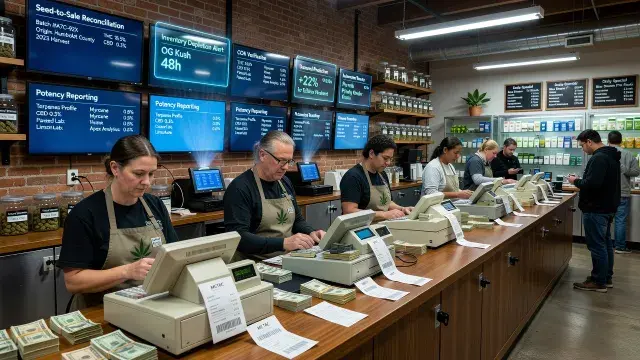
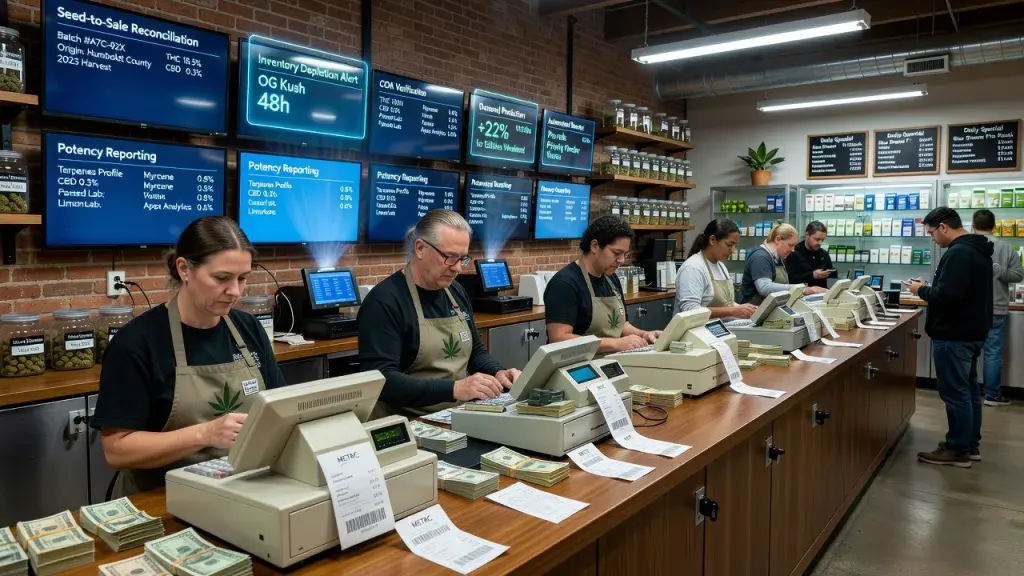
Every few years a new technology arrives promising to make the current dispensary model obsolete overnight. Cashless payment rails, AI-driven inventory forecasting, automated compliance reporting - each gets pitched as the thing that finally replaces the old way of running a cannabis storefront. The pattern is familiar to anyone who watched retail broadly go through this cycle with e-commerce, and the lesson for cannabis operators is the same: the timeline is always longer, and the old systems rarely just disappear.
The Compressed Timeline Problem
Cannabis retail is young enough that most of its operators never lived through the dot-com run-up, but the dynamic repeating itself is familiar. Vendors selling point-of-sale systems, seed-to-sale tracking upgrades, or AI-powered compliance tools often frame adoption as urgent, existential, five years out at most. In practice, though, dispensary operations run on layered infrastructure that doesn't get torn out easily. METRC integrations, state-mandated reporting formats, and legacy POS terminals were built to satisfy specific regulatory requirements, and those requirements don't vanish just because a slicker interface shows up. What tends to happen instead is that new tools get bolted onto old compliance backbones, not swapped in for them.
That's not a knock on innovation. It's a reminder that a retail category still operating under 280E tax restrictions, still navigating license caps, and still reconciling cash-heavy transactions with banking limitations doesn't get to skip steps just because a vendor says the future arrived early.
Why More Software, Not Less, Is Coming to Dispensary Operations
The instinct in some corners of the industry is to assume automation shrinks the amount of software and staffing a dispensary needs. The opposite is more likely. Budroom inventory management, batch-level COA tracking, wholesale menu updates, tax remittance across adult-use and medical channels - every one of these functions is still under-built relative to what operators actually need. AI-enabled tools will move up the stack, handling more of the compliance logging or demand forecasting that used to require manual spreadsheet work. But that doesn't reduce the total footprint of systems a multi-state operator has to run. It just changes which layer does the work.
Consider what dispensary back-office operations looked like a decade ago compared with now. Compliance logs were thinner. Payment processing options were fewer. Track-and-trace requirements were less granular. Today's operator manages far more complexity - state-specific packaging rules, testing thresholds, advertising restrictions near schools, delivery manifest requirements - and tomorrow's operator will manage more still, not less. The idea that AI collapses this complexity into something simpler misreads how regulated retail actually evolves.
What Operators and Suppliers Should Actually Watch
The practical risk isn't that dispensaries fail to adopt new technology. It's that operators bet too heavily on a theoretical end state and under-invest in the compliance fundamentals that remain load-bearing regardless of what platform sits on top.
- Seed-to-sale systems still need to reconcile cleanly with state track-and-trace platforms, no matter how advanced the front-end analytics get.
- Cashless payment solutions remain constrained by federal banking rules, so "new" doesn't mean unregulated.
- Lab testing and COA verification obligations aren't going away; if anything, expect more granular potency and contaminant reporting requirements as the category matures.
- Vertical integration strategies still hinge on licensing structure, not just software sophistication.
What's striking here is how closely this mirrors what happened with big-box retail during its own reckoning with e-commerce. The companies that survived weren't the ones that abandoned logistics and store operations for a purely digital bet. They were the ones that layered new capability onto operational discipline that already worked. Dispensary operators weighing their own technology roadmap would do well to remember that domain expertise in compliance, taxation, and consumer safety isn't a legacy cost to be automated away. It's the foundation everything else gets built on.