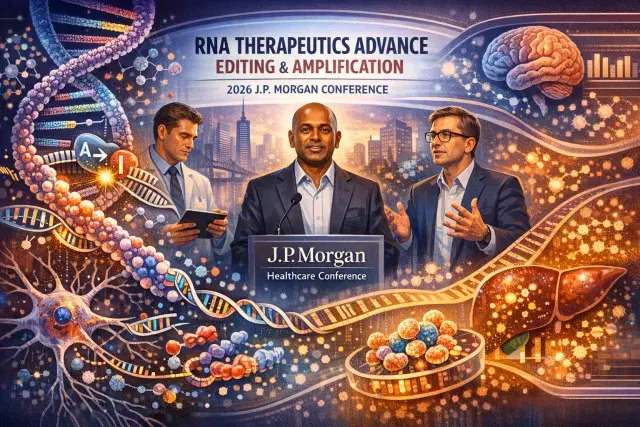
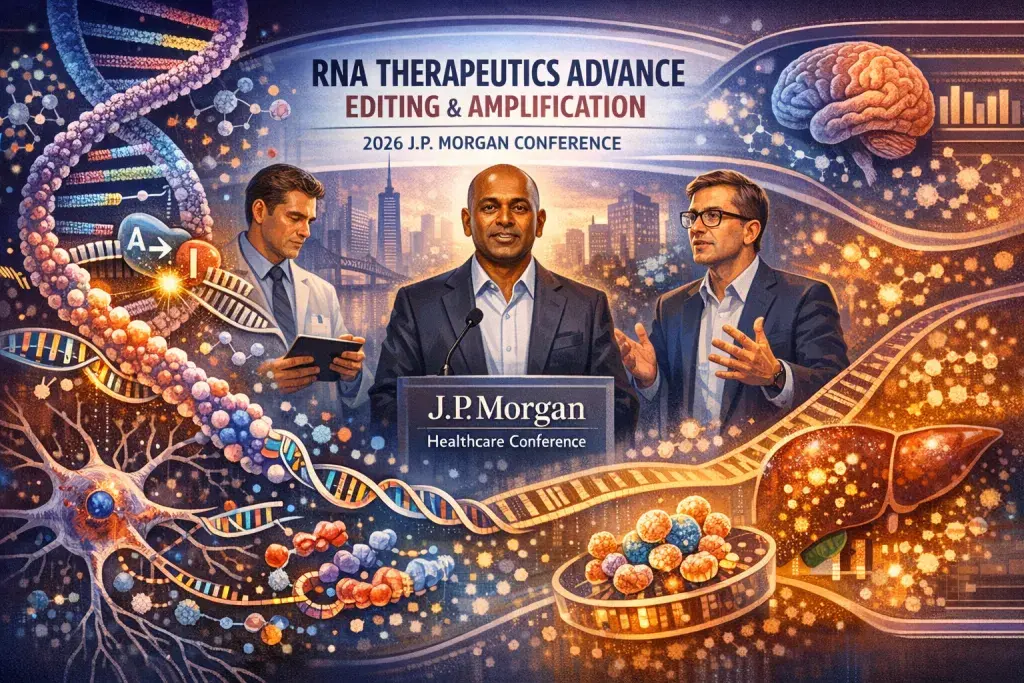
RNA therapeutics drew renewed attention at the 2026 J.P. Morgan Healthcare Conference as companies showcased approaches that edit, repair, and boost gene function without touching DNA. Leaders from Korro Bio, Trace Neuroscience, and CAMP4 Therapeutics described this "middle ground" between permanent gene editing and small-molecule drugs, emphasizing precision, reversibility, and adaptability for chronic diseases. These strategies address limitations of earlier RNA medicines, which focused mainly on silencing genes, and signal broader applications in neurology and metabolism.
Korro Bio Harnesses Natural RNA Editing Enzymes
Korro Bio CEO Ram Aiyar, PhD, highlighted how human cells naturally edit RNA through enzymes like ADAR, which convert adenosine to inosine. The company directs this process with proprietary antisense oligonucleotides for precise changes that avoid DNA alteration. This reversibility suits late-onset or chronic conditions better than lifelong DNA edits, which carry higher risks for less severe cases.
Korro's experience underscores the field's challenges and refinements. Its initial program for alpha-1 antitrypsin deficiency achieved RNA correction and protein repair in humans but failed to reach therapeutic levels, prompting a halt and organizational streamlining. Now, the company prepares to advance KRRO-121 into clinical trials in the second half of 2026 for urea cycle disorders and hepatic encephalopathy. This therapy edits a single amino acid to stabilize a metabolic enzyme, potentially reducing ammonia levels with dosing every two to four weeks—simpler than current treatments. Preclinical results show near-100% RNA editing in animals, suggesting broad potential across the transcriptome.
Trace Neuroscience Targets Splicing Defects in ALS
Trace Neuroscience CEO Eric Green, MD, PhD, focused on RNA splicing corrections for amyotrophic lateral sclerosis (ALS). Nearly all ALS patients lose the UNC13A protein due to faulty splicing caused by TDP-43 dysfunction, not gene sequence errors. Trace's antisense oligonucleotide (ASO) binds UNC13A RNA to restore proper splicing, mirroring the success of ASOs like Spinraza in spinal muscular atrophy.
Preclinical models demonstrate potent UNC13A protein restoration, targeting a pathology in roughly 97% of ALS cases. Intrathecal delivery into cerebrospinal fluid ensures distribution to the spinal cord and cortex, a proven CNS route. The therapy's durability could mean just a few doses per year, easing burdens on patients, regulators, and payers. TDP-43 mis-splicing also drives frontotemporal dementia and some Alzheimer's cases, expanding the approach's reach.
CAMP4 Therapeutics Boosts Healthy Gene Output
CAMP4 Therapeutics CEO Josh Mendel Brehm and CFO Kelly Gold presented methods to increase gene expression via regulatory non-coding RNAs from enhancers and promoters. Antisense oligonucleotides raise output about twofold, ideal for haploinsufficiency disorders where patients make only half the needed protein. The lead program targets SYNGAP1-related neurodevelopmental epilepsy, a severe condition lacking disease-modifying options.
Like Trace, CAMP4 uses intrathecal dosing and established oligonucleotide chemistry for CNS delivery. With partnerships beyond neurology and clinical entry planned for SYNGAP1 this year, CAMP4 operates as a product-driven company built on capital efficiency.
RNA Medicines Reshape Genetic Therapy Landscape
RNA therapeutics originated with silencing strategies for conditions like viral infections and genetic overproduction, but delivery and off-target effects limited early adoption. Advances in chemistry and targeting now enable editing, splicing fixes, and amplification, all transient and grounded in human genetics. These avoid CRISPR-like permanence while offering specificity beyond small molecules.
Implications extend to rare diseases and neurodegeneration, where validated CNS delivery reduces barriers. Risks remain, including dosing frequency and immune responses, but conference discussions stressed patient-centered designs. As these programs progress, RNA positions itself as flexible precision medicine for an expanding range of unmet needs.