
Federal marijuana rescheduling has handed the cannabis industry something it has lacked for years: a credible reason to take medical programs seriously again. After adult-use legalization gutted patient enrollment in state after state, operators now face pressure - regulatory, financial, and competitive - to rebuild a medical infrastructure many quietly dismantled. Whether that rebuild happens will depend less on federal paperwork and more on whether the industry can remember what differentiated medical cannabis in the first place.
The structural argument is straightforward. DEA registration for Schedule III substances opens pathways to banking relationships, conventional financing, and institutional underwriting that remain out of reach in adult-use-only operations. Separating medical and adult-use licenses - where state law allows it - could give operators a compliant entity that qualifies for those benefits. States like California, where cannabis law rests on statute rather than constitutional amendment, have already begun proposing frameworks to make that split workable for existing licensees. For operators tracking these developments across multiple jurisdictions, the back-end technology also matters: systems that handle dual-classification inventory, patient verification, and tax-rate differentiation at the register - tools comparable to what a cannabis point of sale maryland operator would need to manage medical and adult-use transactions under separate compliance rules - will become a practical requirement, not a differentiator.
New Jersey illustrates the erosion precisely. Registered medical patients peaked above 129,000 in mid-2022 and had fallen below 47,000 by May 2026, according to the state Cannabis Regulatory Commission. The math isn't complicated: when adult-use shelves carry comparable or superior product, purchasing limits constrain medical patients but not recreational buyers, and card renewal requires time and money, many patients simply stop renewing. Jeffrey Miller, CEO of New Jersey-based HoneyProjects, which operates both adult-use and dual-license retail under the HoneyGrove brand, put the operator calculus plainly - the compliance burden on the medical side is heavier, the patient perks are thinner, and some of the state's most respected cultivators don't even hold medical licenses. "You would think you'd incentivize people to improve patient access," he said. Instead, the incentive structure has run the opposite direction.
Tax Arithmetic and the Structural Obstacles Operators Face
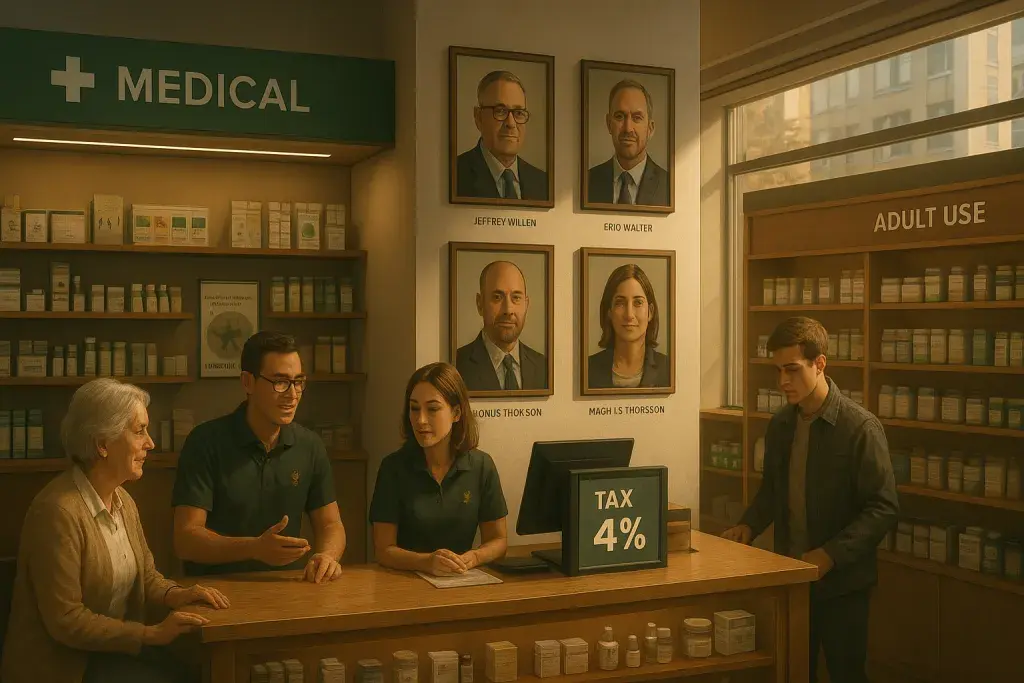
Missouri offers one of the cleaner illustrations of what a functioning tax differential can do. Medical purchases carry a 4% state marijuana tax versus 6% for adult-use, plus local adult-use taxes that can stack on top of that. In a state that recorded $1.5 billion in total cannabis sales last year - including $177.7 million on the medical side - that gap at the register is measurable. St. Louis attorney Eric Walter, who represents the Missouri Cannabis Trade Association and many of the state's licensees, describes the in-store experience as identical except at the point of sale. That's not nothing, but it hasn't been enough to hold the medical market steady.
Here's the catch for Missouri specifically: the state's cannabis framework was established through a constitutional amendment, which makes it nearly impossible for regulators to retroactively separate medical and adult-use licenses to accommodate DEA registration requirements. That's a structural wall. Operators in hybrid-license states face the real possibility that they cannot cleanly qualify as Schedule III registrants without legislative action they can't compel. Walter flags this as a problem that extends well beyond Missouri - any state where licenses were written as combined medical-adult-use instruments could face the same barrier. Operators should be asking their compliance attorneys now, not after DEA guidance firms up.
What Rebuilding Medical Actually Requires
The business case for medical cannabis doesn't rebuild itself just because rescheduling created a legal opening. Magnus Thorsson, professor of Cannabis Studies at Johnson & Wales University and founder of Rhode Island-based Canna Curious Wellness, has been working directly with older consumer communities and sees a demand signal that most dispensary floor sets don't address. Seniors aren't asking about THC percentages or trending cultivars. They're asking whether cannabis fits into a broader wellness routine - and they want evidence-backed answers, not budtender enthusiasm.
"Consumers are demanding more wellness information," Thorsson said. "Rescheduling is going to put the pressure on operators to say pure THC is not the end solution." His broader point is operational: when recreational markets opened, producers stopped cultivating cannabis toward specific conditions and started optimizing for potency and volume. Strains developed with Parkinson's or ALS patients in mind gave way to SKUs engineered to move on adult-use shelves. Rescheduling, if it prompts anything, should prompt a return to condition-specific formulation - products built around multi-cannabinoid profiles rather than THC maximization, with patient education embedded in the retail experience rather than bolted on as an afterthought.
That distinction matters commercially in categories where potency is actually a liability: women's health, senior wellness, and chronic pain management, where patients frequently report concern about intoxication and want dosing guidance more than they want a strong effect. Operators who invest in targeted formulations and condition-specific staff training are positioning for a customer segment that adult-use SKU strategy doesn't reach - and that rescheduling's research pathways could eventually support with clinical evidence.
Medical-Only States Have a Structural Advantage - With Real Limits
Arkansas stays out of the license-separation problem entirely because it remains a medical-only state. With 37 operating dispensaries, a capped cultivation license structure, and active patient enrollment trending upward - the state reported roughly 115,500 active patients as of early May, up several thousand from a year earlier - operators there don't face the hybrid-license complications confronting dual-use markets. Amanda Strickland, CEO of vertically integrated Rogers, Arkansas-based The Source, said her dispensary has been seeing more new patients since rescheduling was announced, tracking up from around 10 per day toward 12 or 14.
That sounds like a clean position. In practice, though, geography complicates it. Strickland notes that two adult-use Missouri dispensaries near the state line each generate more than twice her revenue - with roughly 70% of their customers being Arkansans crossing the border to buy in an adult-use market. The demand is there. The program just can't capture it. That's a ceiling that rescheduling alone won't raise; it would require Arkansas to either expand its medical program's reach or eventually permit adult-use access.
What rescheduling actually offers the medical market is not a guaranteed second act. It offers a set of conditions - research access, potential DEA registration, a more formal regulatory posture - under which operators willing to invest in patient-centered products, wellness education, and compliant dual-licensing structures could build something genuinely distinct from adult-use retail. The operators who treat rescheduling as a tax and banking story are reading the memo too narrowly. The ones paying attention are asking a harder question: what does a dispensary look like when it's actually built around medicine?