One year after Nebraska's Medical Cannabis Commission held its first meeting, the state's program is visibly shifting gears - moving from regulatory formation into the harder, messier work of getting licensed operators into production and patients into dispensaries. The commission's most recent meeting, held Monday in Lincoln, laid out how much has changed and how much remains unresolved. Zoning disputes, construction timelines, and a licensing pipeline that's still filling up are the defining pressures right now.
For operators watching Nebraska's build-out, the parallels to other early-stage state programs are hard to miss. States that have gone through a medical-only launch before transitioning to broader access - or simply scaling a medical framework - tend to hit the same friction points: local jurisdictions that aren't ready, infrastructure that takes longer to permit than to build, and patients who have been waiting long enough that the pace of the rollout feels personal. Regulators in states like Montana worked through similar coordination challenges as they stood up their own frameworks, and tools like dispensary software in Montana became part of how operators there managed compliance workflows while regulations were still being finalized. Nebraska is at that same early inflection point now, where the administrative and operational layers are being stress-tested simultaneously.
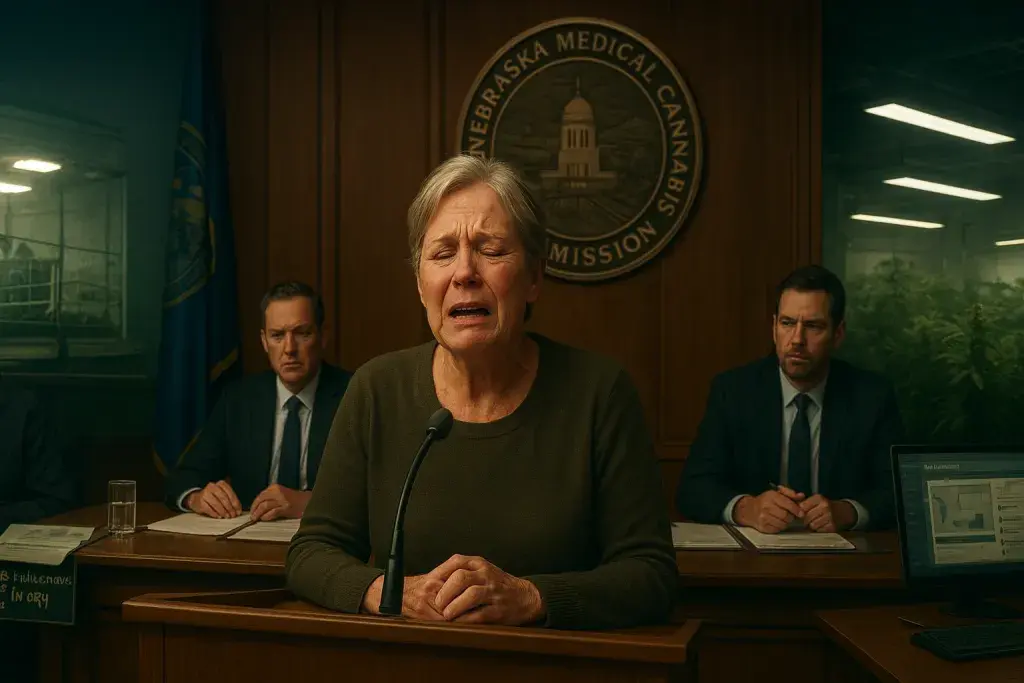
The public comment portion of Monday's meeting made the patient-side urgency concrete. Katrina Eilers, a medically retired military veteran who described nine surgeries and the loss of three organs, told the commission that years of VA-prescribed opioids and benzodiazepines left her with liver and kidney damage and secondary adrenal disease - a condition she said was directly caused by chronic opioid use within prescribed parameters. Her account wasn't an outlier in tone. Multiple speakers became emotional. That kind of testimony matters to a commission that is still setting the terms of access; it's a direct reminder that the distance between a regulatory timeline and a patient's daily reality is not abstract.
A Zoning Dispute Is Holding One Grower in a Costly Holding Pattern
On the cultivation side, the problems are more operational than emotional - though no less consequential. Kent Roger, sole owner of KRL Med LLC, told the commission that Washington County's zoning administration has determined that growing cannabis does not qualify as agriculture. That classification creates a permitting barrier that Roger is now contesting through an appeal to the county's board of adjustment. The county attorney, he said, has not returned calls.
Roger has put roughly $500,000 into his grow operation. That kind of capital commitment, made before a zoning classification dispute surfaced, reflects a risk that cultivators in new-market states routinely underestimate: local land-use rules often haven't caught up with state licensing frameworks. Cannabis cultivation's legal status under state law doesn't automatically resolve how county zoning codes categorize it - agricultural, industrial, commercial, or something else entirely. The gap between those classifications can determine whether a building permit gets issued, and without that permit, nothing grows. Roger was direct about the outcome: no product from his operation this season.
That's not just a setback for one operator. In a new medical program with limited licensed cultivators, any supply interruption at the grow level has downstream implications for manufacturers and dispensaries waiting on product.
One Cultivator Gets Cleared; Capital Deployment Stays Cautious
Robert Wagner of Midwest Cultivator Group offered a more forward-looking update. His operation has received clearance to begin planting - but Wagner was measured about what that means for scaling. He's watching the manufacturer and dispensary licensing pipeline closely before committing significant additional capital. The logic is straightforward: a cultivator who gets too far ahead of the dispensary and manufacturing licensing process ends up holding inventory with nowhere to send it.
Wagner also noted that his operation isn't weather-dependent - it's construction-dependent. Once a shovel goes into the ground, he put the build-out at three to four months. The real constraint is getting on a construction partner's schedule. That's a detail worth noting for any operator planning a facility in a regulated cannabis market: general contractors who work in cannabis builds are not always abundant, and competition for their schedules in new markets can compress timelines in ways that licensing projections don't account for.
The Commission Moves to Collect Manufacturing Applications Early
The commission voted Monday to begin accepting manufacturing license applications immediately, rather than waiting until fees and final regulations are set. The proposal came from commission member James Elworth, whose reasoning was practical: collect the applications now so the commission can act on them the moment the remaining regulatory pieces are finalized, rather than starting the intake process at that point.
That's a sensible administrative move. In early-stage programs, the gap between "regulations finalized" and "licenses issued" often stretches longer than it should because application intake hasn't started. Elworth's proposal compresses that gap. The commission won't be ranking or selecting among applicants yet - just getting paperwork in hand. The next meeting is scheduled for July 20 in Lincoln, which now carries a fair amount of regulatory weight: fees, finalized rules, and the manufacturing licensing process are all converging on that date.
For anyone building a cannabis business in Nebraska - cultivators, manufacturers, prospective dispensary operators - the July 20 meeting is the next concrete checkpoint. The program is moving. It's just moving through the specific friction that every new regulated cannabis market generates before the supply chain actually closes.