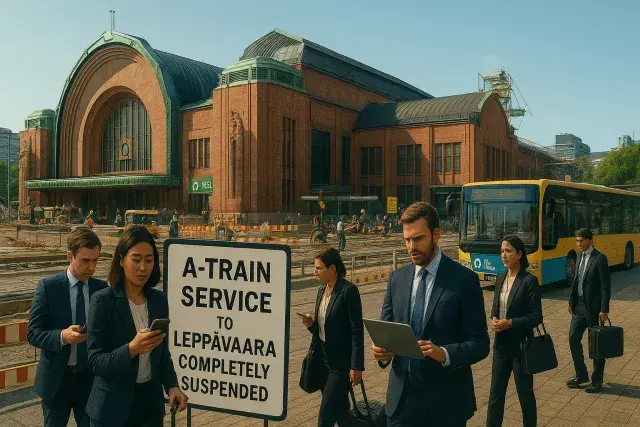

Finland's transport authority HSL has confirmed sweeping commuter-rail service changes running from 1 June through early September 2026, affecting the busiest corridors into Helsinki and the technology-dense suburbs of Espoo. The disruptions stem from track upgrades, bridge repairs, and ongoing construction tied to the Espoo City Rail project - work HSL frames as essential to expand capacity ahead of new rolling stock arriving in 2028. For corporate travel managers and mobility teams coordinating trips to one of northern Europe's most active business destinations, the window is tight and the implications are concrete.
What Gets Cut and Where
The headline impact is a complete suspension of rail traffic between Myyrmäki and Huopalahti from 1 June to 9 August. That closure pulls the I and P airport loop services off their tracks - passengers connecting to or from Helsinki-Vantaa Airport during this stretch will be redirected to replacement buses or alternative routing. That sounds manageable in principle, but in practice it means building meaningful buffer time into any airport transfer, particularly for travellers on early-morning or late-evening itineraries where bus alternatives run less frequently.
The A-train, which links Helsinki Central Station to Leppävaara - home to a dense cluster of technology and professional services firms - will not run at all this summer. For business travellers making that corridor a routine commute or meeting-day trip, it disappears entirely. Separately, long-distance westbound services beyond Leppävaara face a five-week reduction after Midsummer. Flights are unaffected, but that is about the only clean piece of news in this picture.
I-trains serving the airport route will skip four suburban stations and drop to a 20-minute frequency from the usual ten. Outside peak hours, journey times between the airport and Helsinki city centre will lengthen - not dramatically, but enough to flip a comfortable connection into a missed one.
What Corporate Travel and Mobility Teams Should Do Now
The operational ask here is straightforward, even if the execution takes effort. Employers with significant commuter populations in Espoo - particularly in the Keilaniemi and Otaniemi business districts - should be looking at remote-work flexibility and staggered start times through the summer period. Travel-approval workflows and itinerary templates need to be updated to reflect longer transfer windows; an itinerary built on pre-June assumptions will generate preventable delays.
Real-time route planning in English is available through HSL's Reittiopas journey-planner. HSL has also confirmed live disruption alerts via its mobile app and on social media. For passengers with reduced mobility, the agency has committed to operating accessibility buses at closed stations - a detail that mobility coordinators managing diverse traveller populations should note and verify closer to departure.
Car-rental and ride-hail demand is expected to rise across the disruption window, which means both higher pricing and reduced availability during peak hours. Hotels near affected corridors are already flagging potential delays to guests. Getting preferred ground-transport arrangements locked in early - rather than leaving them to travellers' own devices on arrival - is the sensible play.
International Visitors: Entry Requirements Add Another Layer
For international business travellers making Finland a summer destination, the rail disruptions are one variable in a broader logistics picture. Entry requirements vary by nationality, and processing times for visa applications can stretch during high-demand periods. Platforms such as VisaHQ maintain a dedicated Finland page at visahq.com/finland/ that lists current entry requirements, handles online applications for a wide range of nationalities, and offers courier and passport-handling services for those managing tight timelines. Having administrative formalities resolved well ahead of travel - rather than alongside a rerouted itinerary - removes one pressure point from an already compressed schedule.
The broader point is that summer 2026 in Helsinki demands more preparation than usual. The works are temporary. The infrastructure improvements they deliver are not - HSL's argument is that this short-term disruption funds a substantially higher-capacity corridor for decades ahead. That's a reasonable trade-off for the city. For the business traveller catching a Tuesday morning flight to a Keilaniemi board meeting, it mostly means setting the alarm earlier.