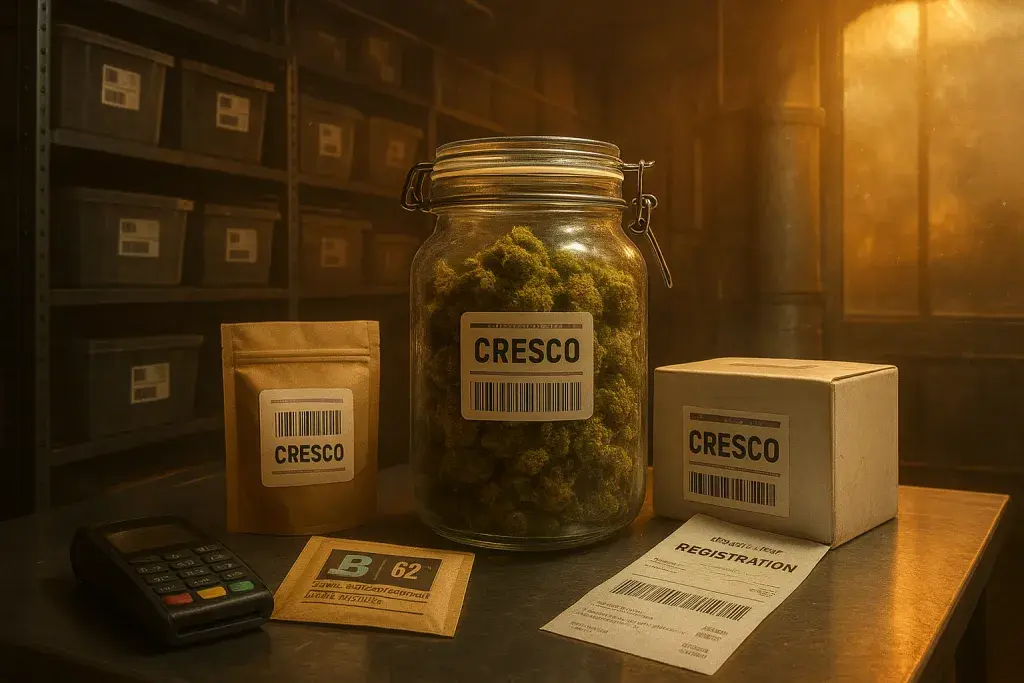
One of the country's larger vertically integrated cannabis operators has formally registered its state-licensed medical cannabis facilities with the U.S. Drug Enforcement Administration - a direct consequence of the federal rescheduling of medical cannabis from Schedule I to Schedule III under the Controlled Substances Act. Cresco Labs announced the registrations on May 27, 2026, covering its dispensary, cultivation, and processing operations that serve medical patients across its footprint. For an industry that has spent years operating in the gap between state legality and federal prohibition, it is a structurally different position to be in.
What Rescheduling Actually Created - and What It Didn't
The reclassification of medical cannabis to Schedule III was significant not just symbolically but mechanically. Schedule III status acknowledges accepted medical use and a lower abuse potential relative to Schedule I and II substances. Critically, it opened a formal DEA registration pathway - with an expedited 60-day process - allowing state-licensed medical cannabis operators to seek federal recognition for specific activities: dispensing, cultivation, processing. Cresco Labs moved through that pathway and came out the other side with registrations covering all three.
Here's the thing, though: federal registration is not a blanket legal clearance. It does not retroactively resolve every compliance complication a multi-state operator carries. It does not automatically rewrite contracts, banking relationships, or insurance arrangements that were structured around a Schedule I reality. What it does do is establish a formal federal acknowledgment that certain state-licensed activities are now operating within a recognized federal category - and that changes the conversation with a range of counterparties, from financial institutions to real estate landlords to wholesale suppliers.
CEO Charlie Bachtell described the registrations as confirmation that the company's work is now federally recognized - framing the development around normalization, reduced operational uncertainty, and patient access. That framing is deliberate and worth understanding on its own terms. For years, "federal recognition" simply wasn't on the table for cannabis operators at any scale. Now it is, at least for the medical side of the business.
The 280E Question Is Still Open
The issue operators and their tax counsel are watching most closely is Section 280E of the Internal Revenue Code. Under 280E, businesses trafficking in Schedule I or II substances cannot deduct ordinary business expenses - no deductions for payroll, rent, utilities, or marketing costs that any other retailer would take as a matter of course. The result has been effective tax rates that bear no resemblance to what comparably sized businesses in other sectors pay. For dispensary operators in particular, 280E has been a persistent, compounding drag on financial performance.
Schedule III reclassification changes the statutory picture - 280E by its text applies to Schedule I and II, not Schedule III. But the practical resolution is not automatic, and the IRS has not issued definitive guidance on how the rescheduling interacts with 280E obligations for tax periods under review or for ongoing operations. Legislative action may still be required to fully resolve the issue. In the meantime, operators are in the uncomfortable position of having a defensible argument that 280E no longer applies to their medical cannabis activities, without certainty about how the IRS and the courts will treat it. DEA registration strengthens that argument's factual foundation - it is harder to maintain that an activity is unrecognized federally when there is a DEA registration number attached to it - but it does not close the loop.
Operational Implications for Multi-State Operators
For a vertically integrated operator like Cresco Labs - with dispensaries, cultivation sites, and processing facilities operating under the same corporate umbrella - DEA registration across all three activity types matters operationally. Seed-to-sale compliance, already tracked through state-mandated systems like METRC, now carries a federal overlay. That doesn't mean METRC reporting changes tomorrow, but it does mean that the compliance infrastructure operators have built - batch tracking, COA documentation, inventory reconciliation, delivery manifests - becomes relevant to a federal regulatory relationship, not just a state one.
Dispensary operations in particular may see downstream effects in areas that have long been friction points: banking access, cashless payment infrastructure, and merchant processing. Financial institutions that have avoided cannabis accounts citing federal Schedule I status now have a different set of facts in front of them for medical operations with DEA registration. Whether that translates into meaningfully expanded banking options in the near term depends on individual institutional risk appetite and their own legal assessments - but the direction has shifted.
Smaller operators watching Cresco Labs' move have a practical question to answer: does pursuing DEA registration make sense for their scale and operational profile? The 60-day expedited pathway was designed to be accessible, but the compliance obligations that attach to a federal registration - record-keeping, reporting, inspection readiness - are not trivial. Operators without robust compliance infrastructure should think carefully about what they are taking on, not just what they stand to gain.
A Marker, Not a Finish Line
The broader industry is right to treat Cresco Labs' registrations as a marker of where the regulatory environment has moved, not a resolution of every outstanding issue. Medical cannabis patients benefit when the operators serving them have stable, recognized legal standing - less operational uncertainty generally means more consistent product availability, supply chain reliability, and investment in the facilities where patients receive care.
But adult-use operations remain outside this federal framework entirely. State-licensed recreational cannabis businesses are not eligible for the Schedule III registration pathway, and they continue to operate under the same federal prohibition that has defined the industry for decades. The asymmetry between the medical and adult-use sides of vertically integrated businesses creates its own compliance complexity - particularly for operators managing shared facilities, employees, and inventory systems across both license types.
What Cresco Labs has done is take a specific, available regulatory step at a moment when the federal framework finally made it possible. That is worth watching closely. The full scope of what these registrations mean - for taxation, banking, interstate commerce discussions, and federal enforcement posture - is still being worked out by lawyers, accountants, regulators, and legislators. The registrations are real. The clarity they provide is partial. And in regulated cannabis, partial clarity is still progress.