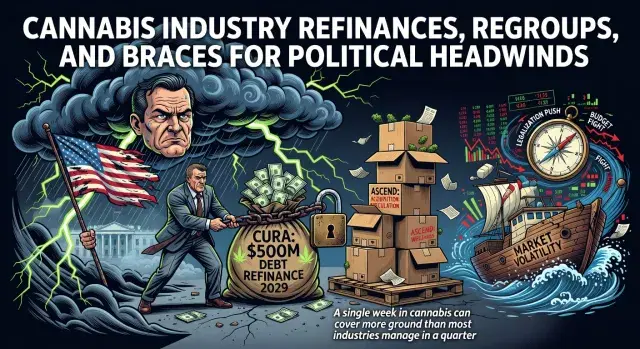
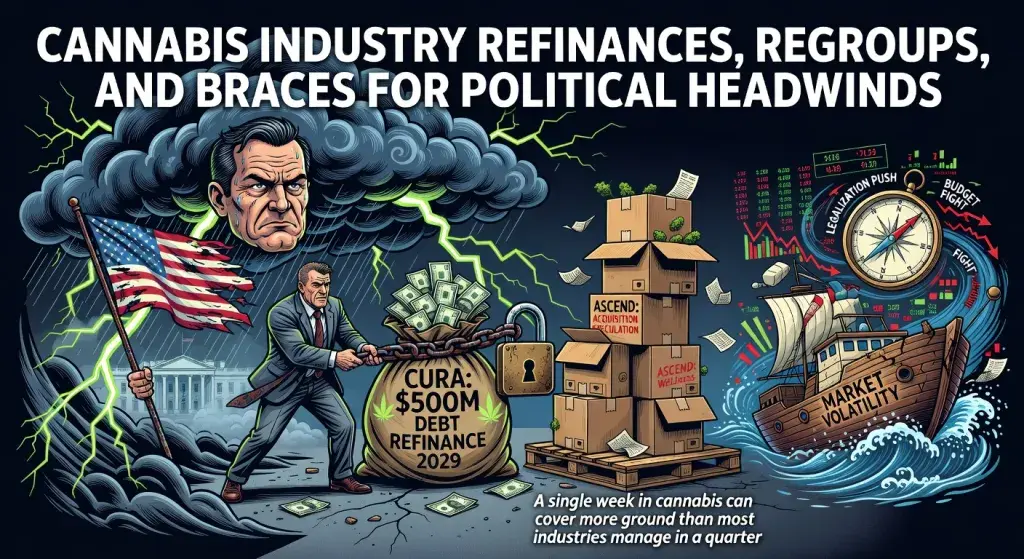
A single week in cannabis can cover more ground than most industries manage in a quarter. That was the takeaway from Monday's episode of Trade To Black, presented by Flowhub, where hosts Shadd Dales and Anthony Varrell worked through a dense stack of developments - from half-billion-dollar debt deals and acquisition speculation to a Republican senator publicly rebuking the White House on rescheduling and a state governor pushing legalization into a budget fight.
Curaleaf and Ascend: Two Refinancing Stories, Different Signals
Curaleaf Holdings (TSX: CURA) announced a $500 million private placement of senior secured notes carrying an 11.5% coupon, extending its debt maturity to 2029. Varrell framed the move as a net positive - it removes a looming balance-sheet overhang - while acknowledging the coupon is steep relative to earlier vintages. In 2021, rates were a different animal entirely. For context, Trulieve recently refinanced its own debt at 10.5%, a gap Varrell attributed to differences in business profile rather than market timing alone. The spread between those two rates tells you something about how capital markets are pricing individual operators, not just the sector.
Ascend Wellness Holdings (OTCQX: AAWH) offered its own, quieter update: preliminary Q4 and full-year figures showing steady revenue growth, healthy EBITDA, and - critically - no major debt maturities until 2029. The hosts flagged Ascend as a more likely acquisition target than an acquirer, a distinction that matters as the industry enters what Dales and Varrell described as a reset phase built around discipline, liquidity, and execution. Translation: the companies that survive the next two years will be the ones that didn't overextend.
Senator Budd, Rescheduling, and the Politics of Cannabis in 2025
The political segment centered on Senator Ted Budd (R-NC), who publicly claimed President Trump had been "poorly advised" on cannabis rescheduling, citing youth safety as his primary concern. It's a familiar objection - and one that tends to resonate with primary voters more than general-election audiences. That distinction matters, and it came up again later in the show during the Pennsylvania discussion.
Guest Michael Bronstein, of the American Trade Association for Cannabis and Hemp, offered a detailed read on Pennsylvania, where Governor Josh Shapiro has once again included adult-use legalization in his state budget proposal, targeting first sales by January 2027. Here's the catch: Republican state senators remain resistant, and Bronstein argued their hesitance is driven less by personal conviction than by the calculus of primary elections. GOP primary voters still skew skeptical on cannabis - but polling among broader Republican demographics is shifting. Whether that shift arrives fast enough to break the legislative logjam in Harrisburg is an open question.
Canopy Growth Stabilizes; Ohio Antitrust Case Looms
Canopy Growth's latest earnings drew rare praise from the hosts. Varrell credited CEO Luke Maggio with stabilizing a company that had, not long ago, looked like it might fly apart. Canadian medical cannabis revenue rose 15% year over year, and adult-use revenue also grew - a combination that suggests operational tightening is actually working, not just being talked about. Canopy remains a name that inspires strong opinions, but the numbers are, for now, moving in the right direction.
Finally, Dales and Varrell teased an upcoming deep dive into a new antitrust lawsuit filed in Ohio, alleging price-fixing and anti-competitive behavior among several multi-state operators. Details remain thin - the hosts promised a fuller treatment soon - but the mere existence of such a suit signals growing regulatory and legal scrutiny of consolidation practices in state-legal markets. If the allegations have substance, the downstream effects could ripple well beyond Ohio.
The Bigger Picture
What connects all of this - the refinancing, the political maneuvering, the antitrust exposure - is an industry that is being forced, by capital markets and by political reality, to professionalize under pressure. The era of cheap capital and speculative exuberance is over. What replaces it will be defined by operators who can manage debt, read political headwinds accurately, and avoid the kind of legal exposure that turns a viable business into a cautionary tale. Not everyone will make it. That's the point.