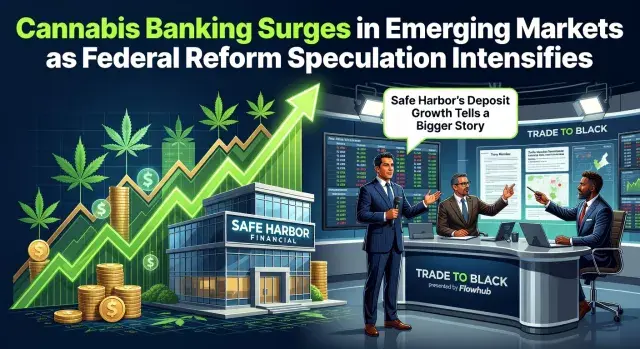
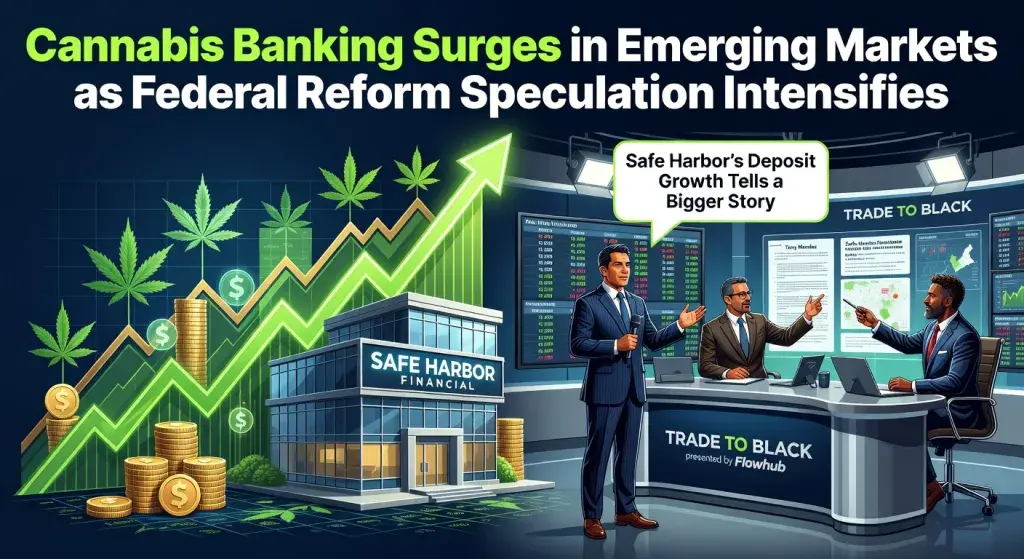
Cannabis equities defied a sharp broader selloff this week, buoyed by a confluence of federal reform signals - from Supreme Court skepticism over firearms bans for marijuana users to Safe Harbor Financial's striking deposit growth in newly legal state markets. The latest episode of Trade To Black, presented by Flowhub, unpacked the financial, legal, and political currents reshaping the sector in real time.
Safe Harbor's Deposit Growth Tells a Bigger Story
Terry Mendez, CEO of Safe Harbor Financial (NASDAQ: SHFS), joined hosts Shadd Dales and Anthony Varrell to detail numbers that say something meaningful about where the cannabis industry is actually expanding. Safe Harbor reported a 29% year-over-year increase in average deposit balances across emerging U.S. markets - with those markets now comprising 31% of total deposits. The growth is concentrated in New York, New Jersey, Connecticut, and Florida, states where licensed operators are still scaling up and, critically, still need banking infrastructure most.
Here's the thing: cannabis banking remains one of the industry's most persistent bottlenecks. Most federally chartered banks still won't touch cannabis money, which means companies like Safe Harbor - one of a handful of cannabis-adjacent firms listed on NASDAQ - occupy an outsized role. Mendez described expanded lending capabilities ranging from $5,000 startup loans to $20 million deals, alongside a rebrand positioning Safe Harbor as a full-service financial and professional services partner. That's not just marketing language. For operators in emerging markets who can't walk into a traditional bank, the difference between having a sophisticated financial partner and operating in a quasi-cash economy is existential.
The Supreme Court Heard Arguments. Investors Should Listen Carefully.
Monday's oral arguments before the Supreme Court centered on whether federal law can constitutionally bar marijuana users from owning firearms. The justices appeared broadly skeptical of the government's position - and one exchange stood out. Justice Gorsuch openly questioned why the case was even before the court given that rescheduling from Schedule I to Schedule III could be imminent.
A DOJ attorney stated that the government had not yet made a final decision on rescheduling. Does that carry a real signal? Or is it boilerplate legal hedging - the kind of thing government lawyers say because they have to? The Trade To Black hosts discussed both readings. The honest answer is that it's ambiguous. But the mere fact that rescheduling was treated as a near-term plausibility inside the Supreme Court chamber matters. It validates the timeline that cannabis investors and operators have been pricing into their assumptions for months.
Cannabis ETFs reflected that optimism: MSOX closed up 4% and MSOS gained 2% on Tuesday, even as the Dow shed hundreds of points. That kind of divergence - cannabis green while the broader market bleeds - doesn't happen without conviction behind it.
Balance Sheet Moves and Ballot Box Signals
MariMed Inc. (CSE: MRMD) restructured its debt, extending maturities by approximately 4.6 years. The move shores up the company's balance sheet ahead of potential federal reform - a defensive play that also signals management believes something meaningful is coming and wants financial flexibility when it arrives. Not a bad bet.
Meanwhile, a Massachusetts poll showed 63% of voters opposed repealing adult-use legalization, with the state having surpassed $9 billion in cumulative cannabis sales since 2016. Public opinion in mature markets appears firmly settled. The political energy now sits on the regulatory and tax side - as evidenced by eight bipartisan Michigan senators moving to repeal the state's recently implemented 24% wholesale tax after January dispensary sales dropped 8.3% year over year. Taxes that suppress legal sales and drive consumers back to the illicit market tend to get reconsidered. Michigan may be learning that lesson in real time.
The Adjacent Market Nobody Expected to Scale This Fast
One final data point worth flagging: the show noted a report finding that nearly 10 million American adults are now microdosing psychedelics. That number, if accurate, represents a market that barely existed in the public consciousness five years ago. For cannabis operators and investors watching adjacent wellness categories, the velocity of normalization is remarkable - and suggests the regulatory frameworks being built for cannabis may eventually need to accommodate a much broader portfolio of substances.
The throughline across all of these stories is the same. Capital is flowing. Legal barriers are eroding - unevenly, frustratingly, but measurably. And the companies positioning themselves now, whether through banking infrastructure, balance sheet discipline, or tax reform advocacy, are the ones likely to capture value when federal policy finally catches up to state-level reality.