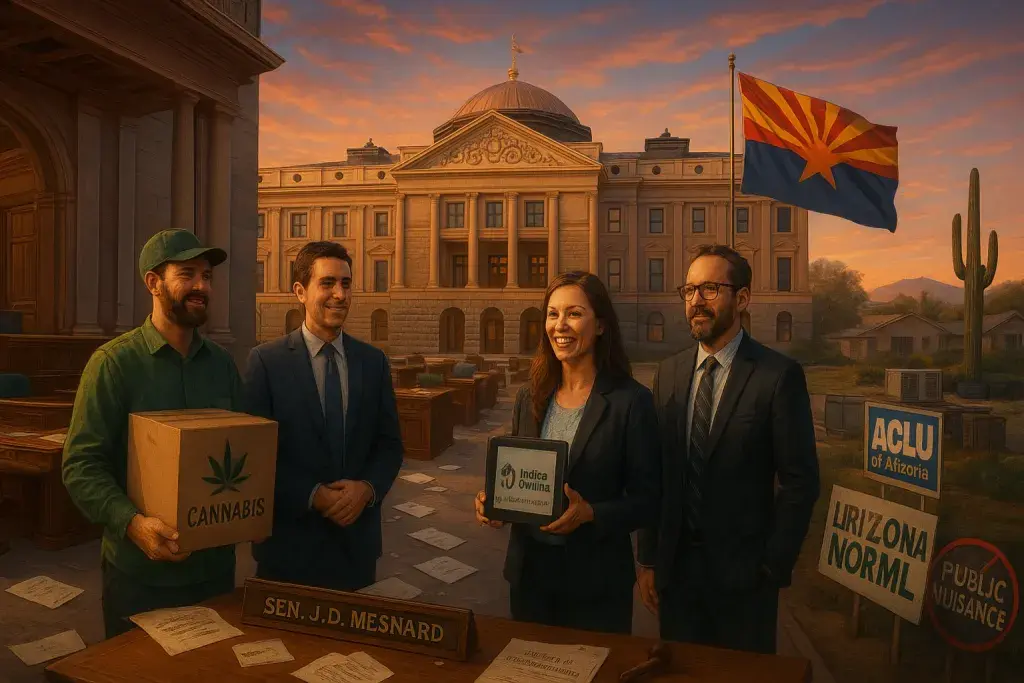
Arizona's SB 1725 - a bill that would have made it a punishable public nuisance to generate what lawmakers defined as "excessive" marijuana smoke or odor - is officially dead for the year after the legislature adjourned its session on June 13 without bringing the measure to a floor vote. For cannabis operators, home cultivators, and licensed businesses across the state, the bill's collapse removes what advocates argued was a legally fragile, enforcement-heavy layer sitting directly on top of a voter-approved adult-use program. The relief is real, but the underlying tension the bill exposed - between neighbors' property rights and cannabis consumers' legal protections - isn't going anywhere.
The legislative fight over SB 1725 isn't an isolated Arizona story. States and municipalities across the country continue to wrestle with how far local authority extends into regulating cannabis use that is otherwise legal under state law. Dispensary compliance teams and multi-state operators already manage a patchwork of municipal zoning rules, odor control requirements at the facility level, and HVAC filtration standards - most of which apply to licensed premises rather than private consumers. Tools like IndicaOnline Montana illustrate how technology vendors are adapting to state-specific compliance demands, an approach that becomes exponentially more complex when localities start layering in use-side restrictions on top of standard seed-to-sale tracking requirements. The question SB 1725 raised - who enforces cannabis behavior outside the licensed retail environment - is one the industry has never had a clean answer to.
What made SB 1725 genuinely complicated was not the intent behind it but the mechanism. As passed by the Arizona Senate, the bill would have made it a public nuisance - punishable by up to four months in jail and a $750 fine - to produce airborne cannabis emissions detectable by a reasonable person on other private property, if those emissions occurred for more than 30 consecutive minutes or on three or more separate days within a 30-day period. That's a specific standard, and on paper it sounds measured. In practice, though, enforcement of subjective odor thresholds is notoriously inconsistent, and cannabis businesses operating delivery routes, outdoor consumption areas, or retail parking lots could have found themselves exposed to complaint-driven enforcement with little predictable footing.
What the Bill Actually Would Have Required - And Who It Targeted
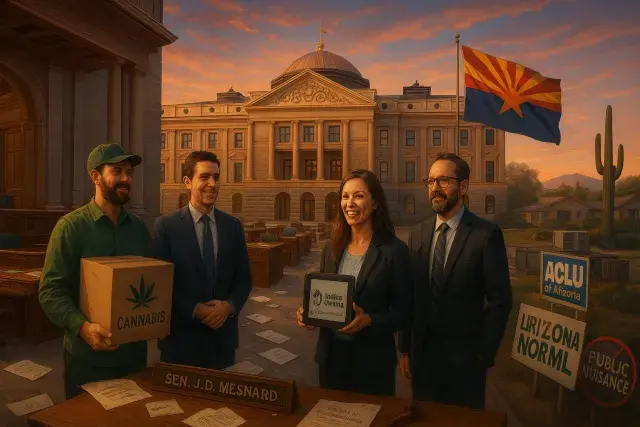
The bill's sponsors revised it significantly from its original form. Early versions introduced broad criminalization language that Arizona NORML and the ACLU of Arizona called a direct rollback of the voter-enacted legalization framework. The Senate Committee of the Whole stripped the most aggressive provisions - removing an explicit reference to a "crime" classification and narrowing the definition of excessive odor - but the core enforcement structure remained intact. Under the final Senate-passed version, a person would have had to receive formal notice of the interference, with a five-day window to abate it, before liability attached. Local officials would have been the first stop for complaints, but only in municipalities that had already adopted their own ordinances. Where no local ordinance existed, the state-level mechanism would have served as the default backstop.
Sen. J.D. Mesnard (R), the bill's sponsor, framed the measure as a property rights protection rather than an attack on legalization. He was direct about not wanting litigation threats to halt policymaking. That's a fair position for a legislator to hold. The problem, as opponents pointed out, is that attaching nuisance liability to legal cannabis consumption - with no parallel framework for tobacco smoke, barbecue smoke, or other common neighborhood odors - created an unequal standard that courts would almost certainly have examined closely. A companion resolution to put the question directly to voters also failed in the Senate, though Mesnard filed a motion to reconsider that defeat; the resolution was never taken up again before adjournment.
The Broader Compliance Risk for Licensed Operators
Here's the thing most B2B observers understood that the public debate mostly missed: even though SB 1725 targeted individual consumers rather than licensed businesses, its passage would have created downstream compliance exposure for dispensaries and cannabis brands. Consumption lounges - an emerging retail format that several Arizona operators have been watching closely - would have faced immediate risk. Any licensed venue permitting on-site cannabis use sits directly in the path of neighbor complaints once a state-level odor nuisance standard exists. The same applies to licensed delivery operations, where a driver parked in a residential area for a routine drop-off could have become a complaint vector.
Licensed operators have spent years building compliance infrastructure around state-mandated facility requirements: filtered ventilation systems, secure waste disposal, locked display cases, compliant packaging, age verification protocols at the point-of-sale. Adding an ambient-use nuisance standard with criminal enforcement teeth would have extended compliance responsibility well beyond the four walls of the licensed premises - and into neighborhoods operators don't control. That's a risk profile no compliance officer can reasonably manage through standard operating procedures.
What Comes Next in Arizona and Elsewhere
The bill is dead for this session. It is not permanently buried. Mesnard's motion to reconsider the companion resolution's Senate defeat keeps at least a procedural thread alive, and the underlying policy argument - that legal cannabis use shouldn't be entirely immune from neighbor complaint mechanisms - will continue to find an audience in state legislatures. Several municipalities already regulate cannabis odor at the local level, and that patchwork is likely to grow regardless of what happens at the state level in Arizona.
For operators, the practical takeaway is straightforward: odor management is already a compliance expectation inside licensed facilities, and the political pressure to extend that expectation outward shows no sign of fading. Watching how cities and counties move on local ordinances - particularly in states with active adult-use programs - is as important as tracking state regulatory updates. The retail compliance calendar doesn't end at the dispensary door.